


What Is Ethereum?
If you’ve ever searched about cryptocurrency, you’ve almost certainly come across two names:
Bitcoin and Ethereum.
Many beginners assume they’re basically the same thing.
After all, both have their own cryptocurrencies, both use blockchain technology, and both are traded on crypto exchanges around the world.
But while they share some similarities, they were created with very different goals.
Bitcoin was designed primarily as a decentralized digital currency.
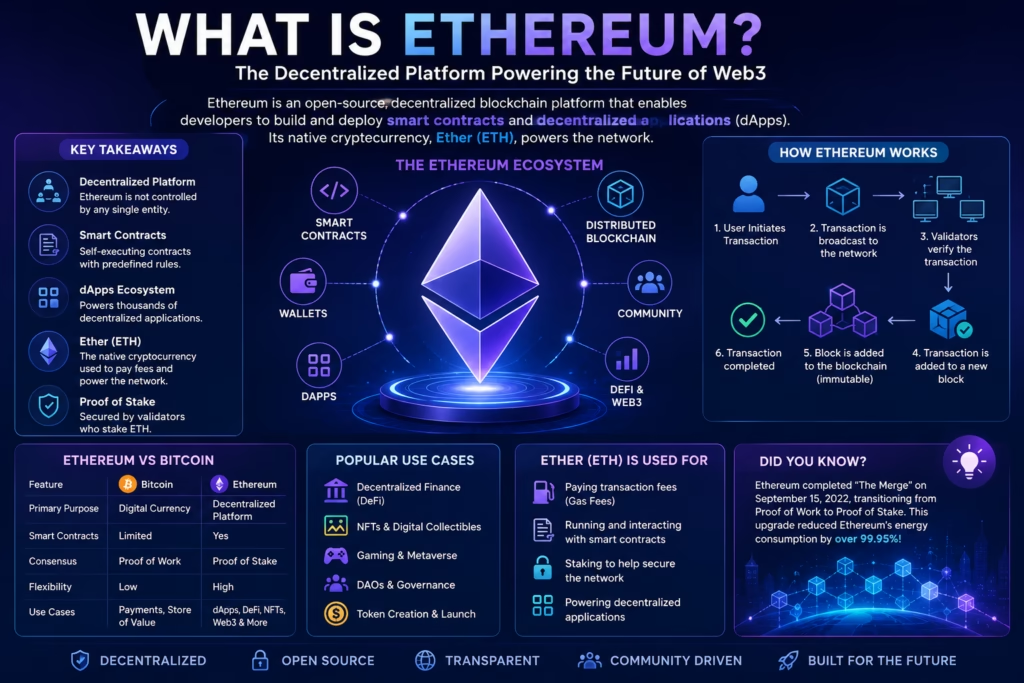
Ethereum took the idea of blockchain much further by creating a platform where developers can build applications, automate agreements through smart contracts, and create entirely new financial systems without relying on a central authority.
Today, Ethereum powers thousands of blockchain-based applications, billions of dollars in digital assets, decentralized finance (DeFi) platforms, NFT marketplaces, blockchain games, and many other services.
Yet many people still wonder:
- What exactly is Ethereum?
- Is Ethereum a cryptocurrency or a blockchain?
- What is Ether (ETH)?
- Why do people compare Ethereum with Bitcoin?
- Why is Ethereum considered one of the most important blockchain networks?
In this guide, we’ll answer all of these questions in simple language, using practical examples instead of technical jargon.
Whether you’re completely new to cryptocurrency or you’ve already learned about Bitcoin, this guide will help you understand why Ethereum has become one of the most influential technologies in the blockchain industry.
Quick Summary
Ethereum is an open-source, decentralized blockchain platform that allows developers to build and run applications without relying on a central company or server.
Its native cryptocurrency is called Ether (ETH).
ETH is used to pay transaction fees, interact with applications on the network, and help secure the blockchain through Ethereum’s Proof of Stake consensus mechanism.
Unlike Bitcoin, which focuses mainly on digital payments and value transfer, Ethereum is designed to support programmable applications through smart contracts.
What Is Ethereum?
Ethereum is a decentralized blockchain network that allows people to build applications that run exactly as programmed without being controlled by a single organization.
Think of Ethereum as a global computing platform shared by thousands of computers around the world.
Instead of storing applications on the servers of one company, Ethereum distributes data and processing across a network of independent participants.
This decentralized design helps improve transparency, resilience, and reduces reliance on a single point of control.
Ethereum has two important parts:
1. Ethereum Network
This is the blockchain itself.
It records transactions, executes smart contracts, and maintains the shared ledger.
2. Ether (ETH)
Ether, often written as ETH, is Ethereum’s native cryptocurrency.
It is used to:
- Pay transaction fees (gas fees)
- Interact with decentralized applications (dApps)
- Reward validators who help secure the network
- Transfer value between users
A simple way to think about it is:
Ethereum is the platform. ETH is the currency that powers it.
Many beginners mistakenly call the cryptocurrency “Ethereum,” but technically the coin is Ether (ETH), while Ethereum is the blockchain network.
A Real-Life Analogy
Imagine your smartphone.
The phone itself is the platform.
The apps running on it perform different tasks.
Now imagine the electricity that powers the phone.
Without electricity, none of the apps can work.
Ethereum works in a similar way.
- Ethereum = the platform
- Smart contracts and dApps = the applications
- Ether (ETH) = the fuel that keeps everything running
This comparison isn’t perfect, but it helps explain the relationship between Ethereum and ETH.
Who Created Ethereum?
Ethereum was proposed in 2013 by Vitalik Buterin, a programmer and blockchain researcher who believed blockchain technology could do much more than simply transfer digital money.
While working within the Bitcoin community, he saw the potential for a blockchain that could support programmable applications instead of focusing mainly on payments.
His proposal attracted other developers and researchers, and after extensive development and fundraising, the Ethereum network officially launched in 2015.
Since then, Ethereum has evolved through several major upgrades, including its transition from Proof of Work (PoW) to Proof of Stake (PoS), a change that significantly reduced the network’s energy consumption while maintaining security.
Why Was Ethereum Created?
Bitcoin demonstrated that decentralized digital money was possible.
Ethereum asked a broader question:
What if blockchain could run software, not just process payments?
Instead of limiting blockchain to recording transactions, Ethereum introduced smart contracts—programs that automatically execute when predefined conditions are met.
This innovation made it possible to build decentralized applications for finance, gaming, digital identity, collectibles, supply chain management, and many other use cases.
Rather than creating a blockchain for one purpose, Ethereum created a platform where developers could build many different kinds of blockchain-powered services.
Key Takeaways
- Ethereum is a decentralized blockchain platform.
- Ether (ETH) is the cryptocurrency used on the Ethereum network.
- Ethereum supports smart contracts and decentralized applications (dApps).
- Thousands of blockchain-based projects are built on Ethereum.
- Ethereum focuses on programmable blockchain technology, making it fundamentally different from Bitcoin’s original purpose.
How Does Ethereum Work?
At first glance, Ethereum can seem complicated.
People often use terms like smart contracts, validators, gas fees, staking, and EVM, making it feel like you need a computer science degree just to understand the basics.
Fortunately, the core idea is much simpler than it appears.
Ethereum is essentially a decentralized computer network. Instead of one company operating a single server, thousands of computers (called nodes) around the world work together to maintain the same shared blockchain.
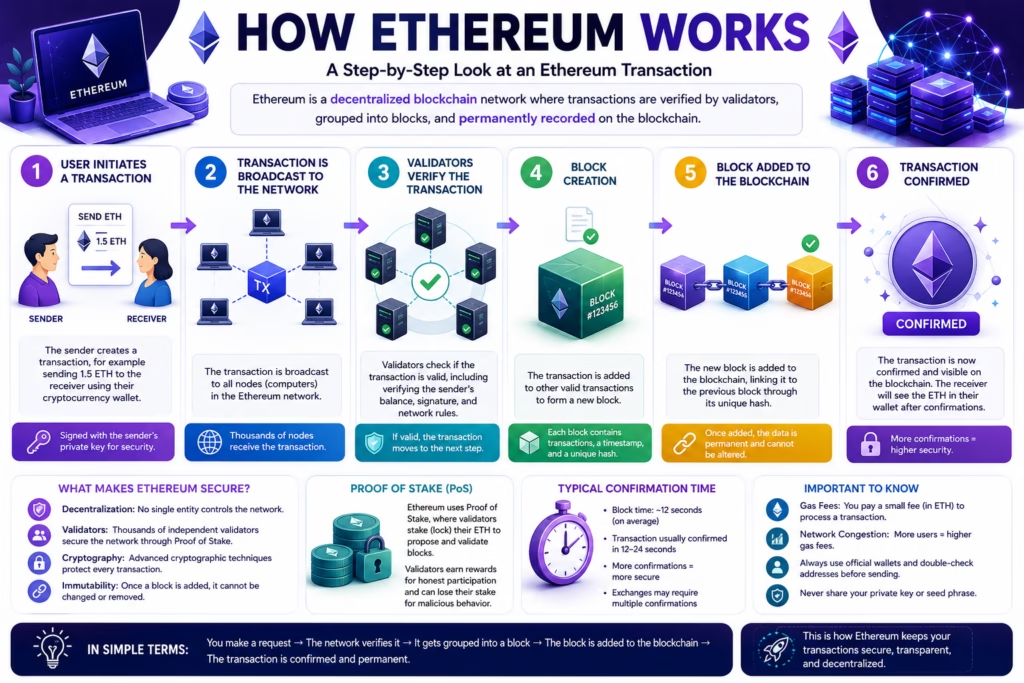
Every participating computer stores a copy of Ethereum’s blockchain and follows the same set of rules. When a new transaction is submitted, the network checks whether it is valid before adding it to the blockchain.
Because many independent participants verify the same information, altering past records becomes extremely difficult. This shared verification process is one of the reasons blockchain technology is considered transparent and resistant to unauthorized changes.
A Simple Example
Imagine Google Docs.
When five people edit the same document, everyone sees the latest version.
Now imagine that instead of Google’s servers keeping the master copy, thousands of independent computers each keep an identical copy.
Before any change becomes permanent, the network agrees that the update follows the rules.
Ethereum works in a similar way, except the “document” is a blockchain containing transactions and smart contracts rather than text.
The Building Blocks of Ethereum
To understand Ethereum, it helps to know its main components.
The Blockchain
The blockchain is a continuously growing record of transactions and other network activity.
Information is grouped into blocks, and each new block is linked to the previous one, forming a chronological chain.
Each block contains information such as:
- Verified transactions
- Smart contract activity
- Time-related metadata
- References to previous blocks
This linked structure helps protect the integrity of the blockchain because changing one block would require changing every block that follows under the network’s consensus rules.
Nodes
A node is any computer running Ethereum software and participating in the network.
Nodes perform important tasks, including:
- Storing a copy of the blockchain
- Sharing information with other nodes
- Verifying transactions
- Helping maintain the decentralized network
Since Ethereum is operated by many independent participants around the world, there is no central server controlling everything.
Validators
Ethereum currently uses a Proof of Stake (PoS) consensus mechanism.
Validators help secure the network by proposing and confirming new blocks.
Instead of using energy-intensive mining equipment, validators lock up (or stake) ETH as part of the network’s security model.
If validators follow the protocol honestly, they can earn rewards. If they behave maliciously or violate important network rules, they may lose a portion of their staked ETH through a process known as slashing.
This economic incentive encourages honest participation.
What Is Ether (ETH)?
Many people casually say:
“I bought Ethereum.”
Technically, what they purchased is Ether (ETH).
Ethereum is the blockchain platform.
Ether is the native cryptocurrency that powers the network.
You can think of it like this:
- Ethereum = the highway
- ETH = the fuel vehicles need to travel on that highway
Without ETH, users generally cannot pay the fees required to interact with the Ethereum network.
What Is ETH Used For?
Ether has several important functions.
Paying Gas Fees
Whenever someone sends ETH or interacts with a smart contract, they usually pay a transaction fee known as gas.
These fees compensate validators for processing and securing transactions.
Securing the Network
Validators stake ETH to participate in securing Ethereum through Proof of Stake.
This helps align incentives between participants and the health of the network.
Using Decentralized Applications
Many decentralized applications require users to pay network fees in ETH when interacting with smart contracts.
Examples include:
- Decentralized exchanges
- Blockchain games
- NFT marketplaces
- Lending and borrowing protocols
- Token transfers
Storing and Transferring Value
Like many cryptocurrencies, ETH can also be transferred between compatible wallets and used as a digital asset.
People may hold ETH for different reasons, including participating in the Ethereum ecosystem or transferring value, but its price can fluctuate significantly and should not be viewed as guaranteed to increase.
What Are Smart Contracts?
One of Ethereum’s biggest innovations is the introduction of smart contracts.
Despite the name, a smart contract is not a paper contract or a legal agreement.
It is simply a computer program stored on the blockchain.
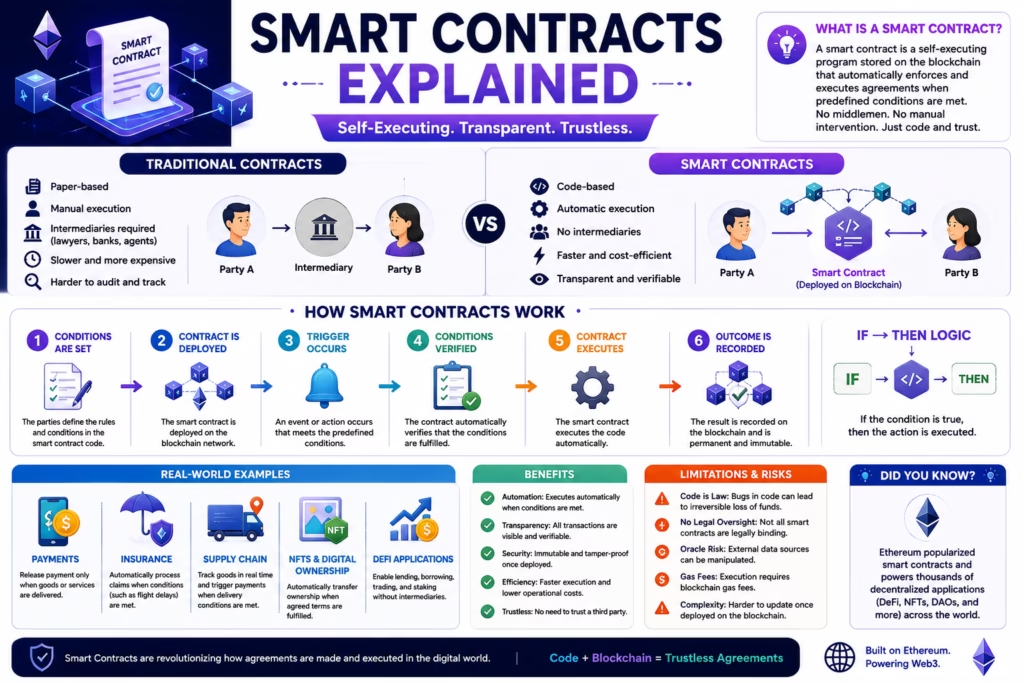
Once deployed, the program automatically executes according to its coded instructions whenever its predefined conditions are met.
Because the code runs on Ethereum’s decentralized network, participants do not need to rely on a single company or intermediary to execute it.
Real-Life Example
Imagine you’re buying a digital product online.
Normally, the process involves:
- Buyer
- Seller
- Payment processor
- Platform
With a smart contract, the logic can be automated.
For example:
- Buyer sends payment.
- Smart contract verifies payment.
- Digital product is delivered automatically.
- Transaction is recorded on the blockchain.
The exact implementation depends on how the application is designed, but the key idea is that the programmed rules execute automatically once the required conditions are satisfied.
Why Are Smart Contracts Important?
Smart contracts can reduce the need for manual processing in many blockchain-based applications.
Potential benefits include:
- Automation
- Transparency
- Consistent execution of programmed rules
- Reduced reliance on centralized intermediaries in some use cases
However, smart contracts are only as reliable as the code they contain. Programming errors or security vulnerabilities can still create risks, which is why auditing and careful development are important.
Did You Know?
Ethereum was the first blockchain platform to popularize programmable smart contracts on a large scale. Today, many other blockchain networks support similar functionality, but Ethereum remains one of the most widely used ecosystems for decentralized applications.
What Are Decentralized Applications (dApps)?
Most of the apps you use every day are controlled by a company.
For example:
- A messaging app is operated by its parent company.
- A social media platform stores your data on its own servers.
- An online banking app is managed by a financial institution.
These are known as centralized applications because a single organization owns and controls the infrastructure, data, and rules.
Ethereum introduced a different approach.
Instead of building applications that run on one company’s servers, developers can create Decentralized Applications, commonly called dApps, that operate on a blockchain.
A decentralized application combines a user interface with smart contracts running on Ethereum. While some parts of a dApp (such as images or websites) may still rely on traditional infrastructure, the core blockchain logic is executed through smart contracts rather than a central server.
Centralized Apps vs Decentralized Apps
Imagine you use a food delivery app.
In a traditional system:
- One company owns the servers.
- That company stores your data.
- It processes payments.
- It decides platform rules.
- It can suspend accounts or modify features.
Now imagine a marketplace where many of these core rules are handled by smart contracts on Ethereum.
Participants interact with the blockchain according to transparent, predefined rules rather than relying entirely on one central authority.
Not every application is suitable for full decentralization, but this model has enabled new types of financial services, digital ownership, and online communities.
Examples of dApps
Ethereum supports thousands of decentralized applications across many sectors.
Some common categories include:
Decentralized Finance (DeFi)
Financial services such as lending, borrowing, and token exchanges built on blockchain networks.
NFT Marketplaces
Platforms where users can create, buy, sell, or trade digital collectibles represented by blockchain tokens.
Blockchain Gaming
Games where certain in-game assets may be owned, transferred, or traded using blockchain technology.
Identity Solutions
Projects exploring decentralized ways for users to manage digital identities and credentials.
Supply Chain Tracking
Applications that record product movement and important events on a blockchain to improve transparency.
Why Are dApps Important?
Traditional applications depend on centralized infrastructure.
If that infrastructure experiences downtime, policy changes, or other issues, users may be affected.
Blockchain-based applications aim to reduce reliance on a single controlling entity for certain functions.
Potential advantages include:
- Greater transparency
- Shared verification of blockchain data
- User-controlled blockchain assets
- Programmable automation through smart contracts
At the same time, decentralized applications also face challenges such as scalability, user experience, regulatory uncertainty, and smart contract security.
What Is the Ethereum Virtual Machine (EVM)?
One of Ethereum’s greatest innovations is the Ethereum Virtual Machine, commonly known as the EVM.
Although the name sounds highly technical, the basic idea is straightforward.
The EVM is the execution environment that runs Ethereum smart contracts.
Whenever a developer deploys a smart contract, it is executed by the Ethereum Virtual Machine across the network.
Because every participating node follows the same execution rules, all nodes arrive at the same result for valid transactions.
This consistency helps maintain the integrity of the blockchain.

A Real-Life Analogy
Imagine a worldwide calculator.
No matter whether someone presses the buttons in India, Germany, Brazil, or Japan, everyone receives the same answer because every calculator follows the same mathematical rules.
The EVM behaves similarly.
Regardless of where a node is located, it executes smart contract instructions according to the same protocol, helping ensure predictable outcomes.
Why Is the EVM Important?
The Ethereum Virtual Machine allows developers to build blockchain applications without creating an entirely new blockchain from scratch.
Instead, they can deploy smart contracts on Ethereum and benefit from its established infrastructure and security model.
Another reason the EVM became influential is that many other blockchain networks adopted EVM compatibility.
This allows developers to reuse familiar tools and, in many cases, adapt existing Ethereum applications for compatible networks with less effort.
What Are Gas Fees?
One of the first things new Ethereum users notice is something called a gas fee.
Every time you perform an action on Ethereum—such as sending ETH or interacting with a smart contract—you generally pay a network fee.
This fee is known as gas.
Gas represents the computational resources required for the network to process and record your transaction.
Rather than being a penalty or subscription charge, gas helps compensate validators for the work involved in maintaining the blockchain.
Why Does Ethereum Charge Gas Fees?
Imagine sending a package through a courier service.
The farther or more complex the delivery, the more resources are required.
Similarly, different blockchain operations require different amounts of computational work.
Simple ETH transfers usually require fewer resources than executing complex smart contracts.
Gas fees also help discourage spam by making it costly to flood the network with meaningless transactions.
Why Do Gas Fees Change?
Ethereum gas fees are not fixed.
They can increase or decrease depending on network demand.
For example:
- During periods of high activity, more users compete to have their transactions processed, which can increase fees.
- During quieter periods, fees often decrease.
This is similar to surge pricing in ride-sharing services, where prices change based on demand.
Proof of Stake (PoS)
When Ethereum launched in 2015, it used a consensus mechanism called Proof of Work (PoW), similar to Bitcoin.
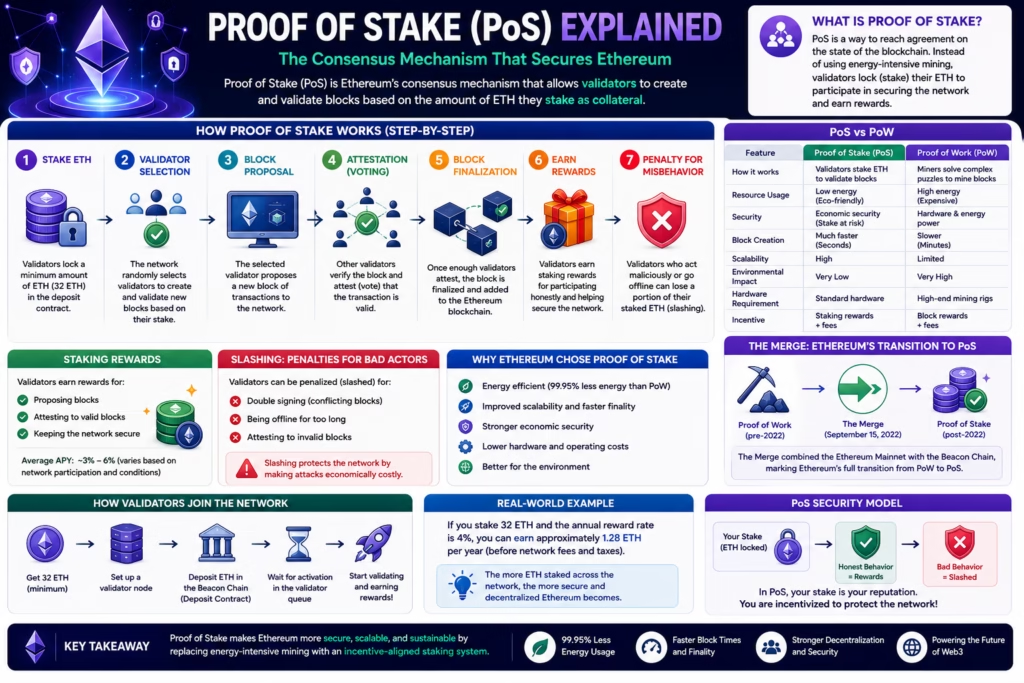
In September 2022, Ethereum completed a major network upgrade known as The Merge, transitioning to Proof of Stake (PoS).
Under Proof of Stake, validators secure the network by staking ETH rather than competing with specialized mining hardware.
This transition significantly reduced Ethereum’s energy consumption while maintaining the network’s security model.
How Does Proof of Stake Work?
Validators lock up a required amount of ETH to participate in block validation.
The protocol selects validators according to its rules to propose and attest to new blocks.
Honest participation can earn rewards, while serious protocol violations may result in penalties, including slashing.
This economic model encourages validators to act in the network’s best interests.
Did You Know?
Ethereum’s transition from Proof of Work to Proof of Stake is widely regarded as one of the most significant upgrades in blockchain history because it fundamentally changed how the network is secured without requiring users to migrate to a new blockchain.
Key Takeaways
By now, you’ve learned that Ethereum is much more than a cryptocurrency.
It provides an ecosystem where developers can:
- Build decentralized applications
- Deploy smart contracts
- Create digital assets
- Develop financial protocols
- Explore blockchain-based identity, gaming, and many other use cases
These capabilities have made Ethereum one of the most influential blockchain platforms in the world.
Ethereum vs Bitcoin
Whenever people begin learning about cryptocurrency, one of the first questions they ask is:
“Which is better: Bitcoin or Ethereum?”
The answer depends on what you’re comparing.
Although Bitcoin and Ethereum are the two largest blockchain networks by market recognition, they were designed with different objectives.
Bitcoin was introduced in 2009 with the goal of creating a decentralized digital currency that allows people to transfer value without relying on banks or governments. Because of its limited supply and long history, many people refer to Bitcoin as “digital gold.”
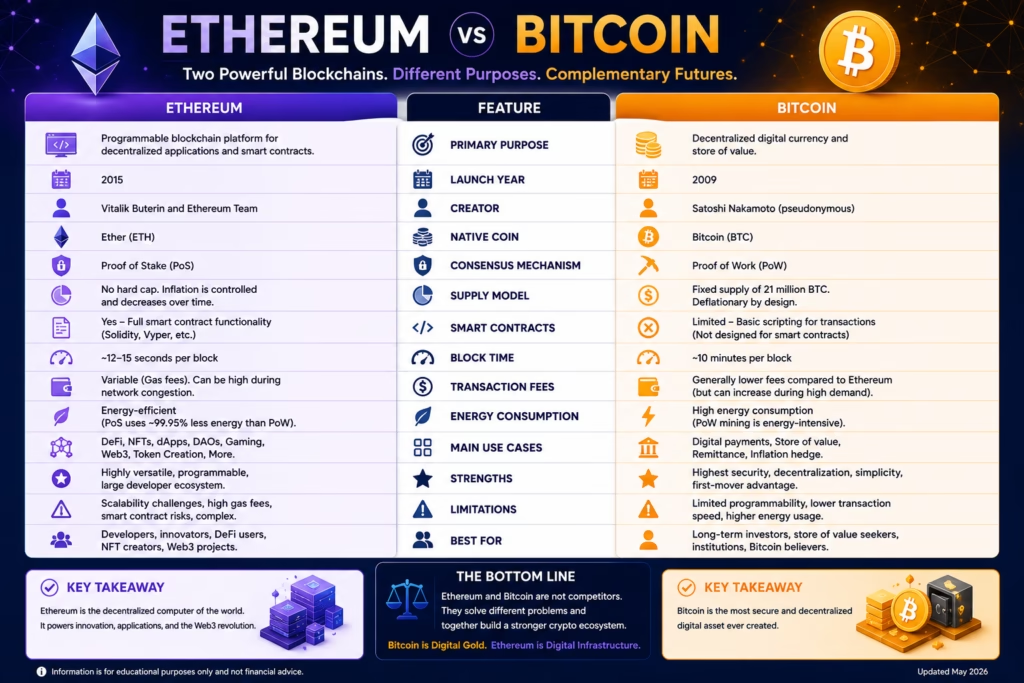
Ethereum, launched in 2015, expanded the possibilities of blockchain technology. Rather than focusing only on digital money, Ethereum provides a programmable platform where developers can build decentralized applications, automate agreements through smart contracts, and create entirely new blockchain-based services.
In simple terms:
- Bitcoin focuses on decentralized money.
- Ethereum focuses on decentralized computing.
Neither network replaces the other. Instead, they solve different problems within the blockchain ecosystem.
Bitcoin vs Ethereum Comparison
| Feature | Bitcoin | Ethereum |
|---|---|---|
| Primary Purpose | Digital currency and store of value | Programmable blockchain platform |
| Native Coin | Bitcoin (BTC) | Ether (ETH) |
| Launch Year | 2009 | 2015 |
| Founder | Created by the pseudonymous Satoshi Nakamoto | Proposed by Vitalik Buterin |
| Smart Contracts | Limited scripting capabilities | Full smart contract functionality |
| Decentralized Applications | Not designed for this purpose | Core feature of the platform |
| Consensus Mechanism | Proof of Work | Proof of Stake |
| Main Use Cases | Payments, savings, value transfer | DeFi, NFTs, gaming, DAOs, Web3, token creation |
Rather than asking which one is “better,” it’s more useful to understand what each network was built to do.
Real-World Uses of Ethereum
Ethereum is no longer just a blockchain for cryptocurrency transfers. Over the years, developers have built thousands of applications on top of it, creating an ecosystem that supports finance, gaming, digital ownership, identity, and much more.
Here are some of the most common use cases.
Decentralized Finance (DeFi)
One of Ethereum’s most influential innovations is Decentralized Finance, often abbreviated as DeFi.
Traditional financial services usually rely on banks or other institutions to facilitate activities such as lending, borrowing, or exchanging assets.
DeFi applications aim to provide similar services through smart contracts, allowing users to interact directly with blockchain-based protocols.
Examples of DeFi activities include:
- Swapping digital assets
- Lending cryptocurrency
- Borrowing against digital assets
- Providing liquidity to decentralized exchanges
It’s important to understand that DeFi carries significant risks, including smart contract vulnerabilities, market volatility, and regulatory uncertainty. Users should research carefully before participating.
Non-Fungible Tokens (NFTs)
Ethereum helped popularize NFTs (Non-Fungible Tokens).
An NFT is a unique blockchain-based token that can represent ownership of a digital or physical asset.
NFTs have been used for:
- Digital artwork
- Music
- Collectibles
- Event tickets
- Gaming items
- Membership access
- Certificates
Owning an NFT does not automatically grant copyright or intellectual property rights unless those rights are explicitly included by the creator.
Blockchain Gaming
Many blockchain-based games use Ethereum or Ethereum-compatible networks.
In some games, players can own in-game assets such as characters, equipment, or collectibles as blockchain tokens.
However, blockchain gaming is still an evolving industry, and gameplay quality, economics, and ownership models vary significantly between projects.
Token Creation
Ethereum introduced a standardized way to create blockchain tokens through widely adopted token standards such as ERC-20.
Thousands of projects have launched their own tokens on Ethereum for purposes such as governance, utility, fundraising, and ecosystem participation.
While token creation has enabled innovation, it has also been used for fraudulent schemes. Users should evaluate projects carefully rather than assuming every token is legitimate.
Decentralized Autonomous Organizations (DAOs)
A Decentralized Autonomous Organization (DAO) is a blockchain-based governance structure where participants vote on proposals according to predefined rules.
DAOs are used by some projects to make decisions about funding, protocol upgrades, and community initiatives.
Different DAOs operate under different legal and governance frameworks, so participation does not guarantee legal rights similar to those found in traditional organizations.
Advantages of Ethereum
Ethereum has become one of the world’s leading blockchain platforms because of several key strengths.
Programmability
Developers can build a wide range of applications without creating a new blockchain from scratch.
Large Developer Community
Ethereum has one of the largest and most active blockchain developer ecosystems, contributing to continuous innovation and educational resources.
Mature Ecosystem
The network supports thousands of applications, wallets, tools, and services, making it one of the most established blockchain platforms.
Smart Contract Support
Ethereum popularized programmable smart contracts, enabling many of today’s decentralized finance and Web3 applications.
Continuous Development
The Ethereum community continues to research and implement upgrades aimed at improving scalability, efficiency, and usability.
Limitations and Risks
No technology is perfect, and Ethereum is no exception.
Network Congestion
During periods of heavy activity, transactions may take longer to process, and fees can increase.
Gas Fees
Although upgrades have improved the ecosystem, interacting with Ethereum can still become expensive when network demand is high.
Smart Contract Risks
If a smart contract contains coding errors or security vulnerabilities, users may experience financial losses.
Price Volatility
Like many cryptocurrencies, ETH’s market price can change rapidly. Anyone considering buying digital assets should understand the risks involved.
Regulatory Uncertainty
Cryptocurrency regulations continue to evolve in many countries. Future legal developments may affect how blockchain projects operate or are accessed.
Common Myths About Ethereum
Myth 1: Ethereum and Ether are the same thing.
Reality: Ethereum is the blockchain platform, while Ether (ETH) is the network’s native cryptocurrency.
Myth 2: Ethereum is only used for buying and selling cryptocurrency.
Reality: Ethereum supports decentralized finance, digital ownership, blockchain gaming, decentralized identity, governance systems, and many other applications beyond simple payments.
Myth 3: Smart contracts are legal contracts.
Reality: A smart contract is a computer program that executes predefined instructions. Whether it has legal significance depends on applicable laws and the specific agreement between parties.
Myth 4: Ethereum transactions are completely free.
Reality: Most interactions with the Ethereum network require gas fees, which compensate validators for processing transactions.
Frequently Asked Questions
Is Ethereum a cryptocurrency?
Ethereum is the blockchain platform. Ether (ETH) is the cryptocurrency used on that platform. In everyday conversation, many people use the word “Ethereum” when referring to ETH, but technically they are different.
What is ETH?
ETH, or Ether, is Ethereum’s native cryptocurrency. It is used to pay transaction fees, participate in staking, and interact with decentralized applications.
Can Ethereum be mined?
Ethereum no longer uses traditional mining. Since transitioning to Proof of Stake in 2022, the network is secured by validators who stake ETH.
Is Ethereum better than Bitcoin?
They serve different purposes. Bitcoin primarily focuses on decentralized digital money and long-term value storage, while Ethereum is designed to support programmable blockchain applications.
Why do Ethereum transactions require gas fees?
Gas fees compensate validators for processing transactions and help protect the network from spam and abuse.
What are smart contracts?
Smart contracts are programs stored on the blockchain that automatically execute according to predefined rules once specific conditions are met.
Is Ethereum safe?
Ethereum is one of the most widely used blockchain platforms in the world. However, using any blockchain involves risks, including phishing attacks, wallet security issues, malicious smart contracts, and market volatility. Users should follow good security practices and conduct independent research before interacting with blockchain applications.
Final Thoughts
Ethereum transformed blockchain technology from a system primarily designed for digital payments into a platform capable of supporting decentralized applications, programmable agreements, and new forms of digital ownership.
By introducing smart contracts and fostering a large developer ecosystem, Ethereum became the foundation for many innovations in decentralized finance, NFTs, blockchain gaming, and Web3.
Understanding Ethereum is not just about learning what ETH is or how transactions work. It is about understanding how programmable blockchains have expanded the possibilities of decentralized technology.
Whether you’re exploring cryptocurrency for the first time or building a deeper understanding of blockchain, Ethereum is one of the most important technologies to study because of its continuing influence on the broader digital asset ecosystem.
Continue Learning
If you’re new to blockchain, these guides provide a logical next step:
- What Is Bitcoin?
- What Is Blockchain?
- How Bitcoin Wallets Work? Complete Beginner’s Guide (2026)
- Bitcoin Mining Explained: How New Bitcoins Are Created (2026)
- Public Key Vs Private Key: What’s The Difference? (2026)
- How Bitcoin Transactions Work: Step-by-Step Guide (2026)
- What Is A Bitcoin Address? (2026 Beginner Guide)
- What Is A Seed Phrase? A Complete Beginner’s Guide (2026)
- Hot Wallet Vs Cold Wallet: What’s The Difference? (2026 Guide)
References
Use authoritative sources when reviewing or updating this article, including:
- Ethereum Foundation documentation
- Ethereum.org educational resources
- Ethereum Improvement Proposals (EIPs)
- Academic research on blockchain technology
- Reputable industry publications and official protocol documentation