

What Is Bitcoin?
Imagine sending money to someone living on the other side of the world without asking a bank for permission, waiting for business hours, or paying high transfer fees. You simply open an app, enter the recipient’s address, and send the payment directly.
That idea may sound ordinary today, but when Bitcoin was introduced in 2009, it challenged the traditional way people thought about money.
Bitcoin is a digital crypto currency that allows people to transfer value directly to one another over the internet without relying on a central authority such as a bank or government. Instead of being managed by a single company, Bitcoin operates through a decentralized network of computers spread across the world.
Unlike paper currencies, Bitcoin exists only in digital form. There are no physical Bitcoin notes or coins. Every transaction is recorded on a public ledger known as the blockchain, making the network transparent while allowing anyone to verify transactions independently.
Today, Bitcoin is used in different ways. Some people use it to transfer money internationally, others see it as a long-term investment, while businesses and financial institutions continue exploring its role in the global financial system.
Understanding Bitcoin is no longer just about cryptocurrency. It is about understanding how digital money, decentralized technology, and modern finance are evolving together.
Quick Summary of What Is Bitcoin?
If you’re new to cryptocurrency, here are the most important things to know about Bitcoin:
- Bitcoin is a decentralized digital currency.
- It was introduced in 2009 after the publication of the Bitcoin whitepaper in 2008.
- No government or bank controls the Bitcoin network.
- Every transaction is verified by thousands of computers around the world.
- Bitcoin has a maximum supply of 21 million coins, making it a scarce digital asset.
- Transactions are recorded permanently on a blockchain.
- Bitcoin can be transferred globally without traditional banking systems.
Why Was Bitcoin Created?
To understand Bitcoin, it helps to understand the problem it was trying to solve.
Traditional financial systems depend on trusted intermediaries such as banks, payment processors, and governments. Whenever you send money online, your transaction usually passes through multiple institutions before reaching the recipient.
While this system works well in many situations, it also has limitations:
- International transfers can take several days.
- Banking services are unavailable to millions of people worldwide.
- Transactions may be delayed or blocked.
- Multiple intermediaries often increase costs.
In October 2008, during the global financial crisis, an individual or group using the name Satoshi Nakamoto published a paper titled “Bitcoin: A Peer-to-Peer Electronic Cash System.”
The proposal introduced a completely different approach. Instead of trusting one central institution, Bitcoin would rely on mathematics, cryptography, and a decentralized network of participants to verify transactions.
This meant that people could exchange digital value directly without needing permission from a central authority. Whether someone supports Bitcoin or not, the idea represented one of the most significant innovations in digital finance.
Who Created Bitcoin?
The creator of Bitcoin remains one of the biggest mysteries in technology.
The Bitcoin whitepaper was published under the name Satoshi Nakamoto in October 2008. However, no one has publicly proven who Satoshi really is. Some researchers believe Satoshi was a single developer, while others believe it may have been a group of people working together.
What is publicly known is that:
- The Bitcoin whitepaper was published in 2008.
- The Bitcoin network officially launched on 3 January 2009 with the creation of the Genesis Block.
- Satoshi remained active during Bitcoin’s early development before gradually stepping away from public communication.
The identity of Satoshi Nakamoto has never been officially confirmed. Because of this uncertainty, any article claiming to know the real identity of Bitcoin’s creator should be treated carefully unless supported by credible evidence.
What Makes Bitcoin Different?
Many digital payment systems already existed before Bitcoin.
So why did Bitcoin become different?
The answer lies in its design.
Bitcoin combines several technologies into one decentralized system:
- Blockchain technology records every transaction.
- Cryptography protects ownership.
- Thousands of independent computers verify transactions.
- A fixed supply creates scarcity.
- Open-source software allows anyone to inspect how the network works.
Unlike a traditional bank account, no single organization can change Bitcoin’s monetary supply or control who is allowed to participate in the network.
That decentralized structure is one of Bitcoin’s defining characteristics and one of the main reasons it has attracted global attention over the past decade.
How Does Bitcoin Work?
At first glance, Bitcoin may look like a digital payment app. In reality, it is a global network made up of thousands of independent computers that work together to record, verify, and secure transactions without relying on a central authority.
When someone sends Bitcoin, the transaction does not travel through a bank. Instead, it is broadcast to the Bitcoin network, where independent participants verify that the sender owns the Bitcoin being transferred and has not already spent it elsewhere.
Once verified, the transaction becomes part of Bitcoin’s permanent public ledger—the blockchain.
Understanding Bitcoin Through a Simple Example
Imagine you want to send 0.1 BTC to your friend living in another country.
The process looks like this:
You
│
▼
Bitcoin Wallet
│
▼
Bitcoin Network
│
▼
Network Verification
│
▼
Block Confirmation
│
▼
Blockchain
│
▼
Friend Receives Bitcoin
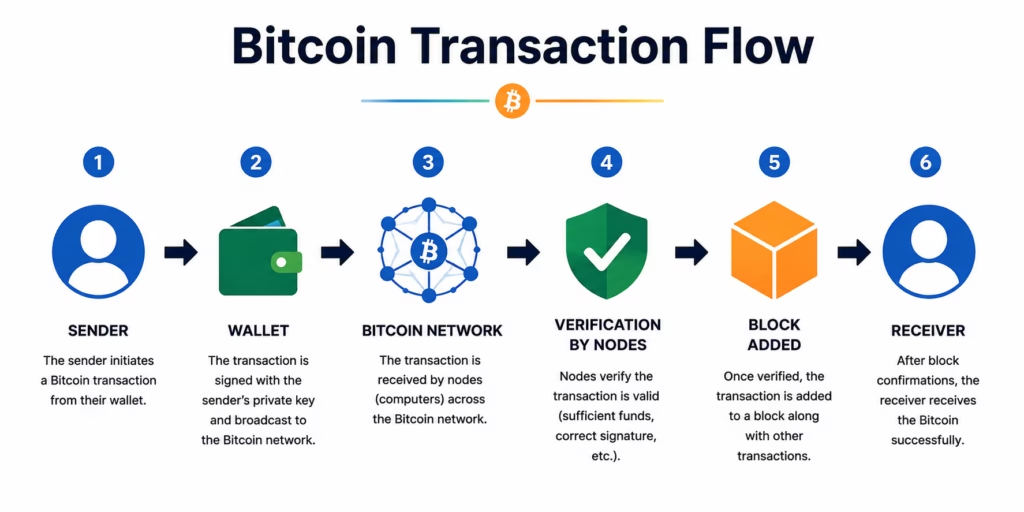
Unlike traditional banking systems, no single company approves this payment. The network itself validates it according to predefined rules.
What Is Blockchain?
One of the biggest misconceptions is that Bitcoin and blockchain are the same thing.
They are closely related, but they are not identical.
Think of the blockchain as a public accounting ledger.
Imagine a notebook that records every Bitcoin transaction ever made. Instead of being stored in one office, identical copies of this notebook exist on thousands of computers worldwide.
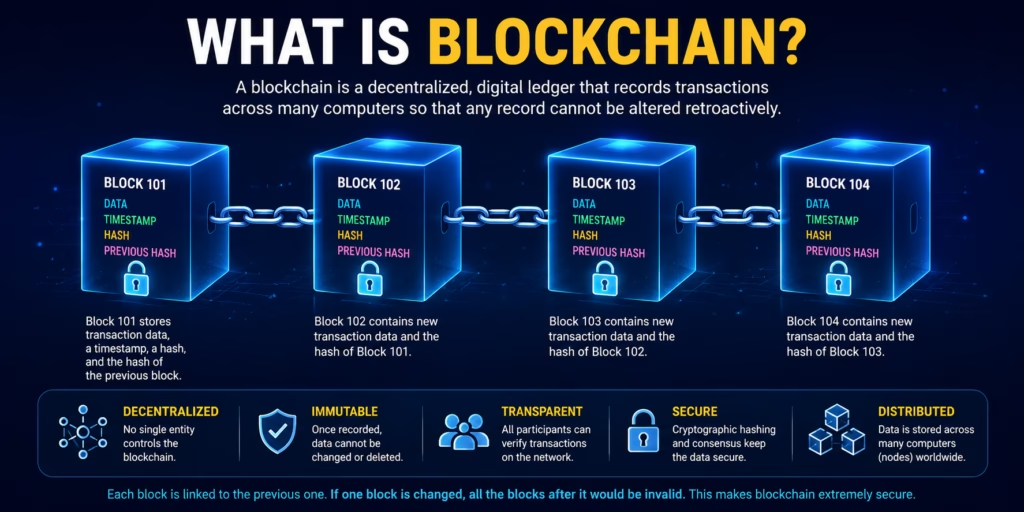
Whenever a new transaction is verified, every copy of the notebook is updated with the same information.
Because thousands of participants maintain the ledger, secretly changing or deleting previous records becomes extremely difficult.
This shared ledger is called the blockchain.
Each new group of verified transactions is stored inside a “block.” Every new block is linked to the previous one, creating a continuous chain of records—hence the name blockchain.
Why Is Blockchain Important?
Without blockchain technology, Bitcoin would face a serious problem called double spending.
Imagine sending the same ₹1,000 to two different people at exactly the same time.
With physical cash, this isn’t possible because the note can only exist in one place.
Digital money, however, can theoretically be copied like a computer file.
Blockchain solves this problem by maintaining a single, shared transaction history that the network agrees upon.
Once a transaction becomes part of the blockchain, everyone can independently verify it.
What Are Bitcoin Nodes?
A Bitcoin node is simply a computer running Bitcoin software.
Its primary responsibility is not mining—it is verification.
Every full node checks whether each transaction follows Bitcoin’s rules.
For example, a node verifies:
- Does the sender actually own these bitcoins?
- Has the Bitcoin already been spent?
- Does the transaction follow Bitcoin’s protocol?
If the answer is “yes,” the transaction is accepted.
If not, it is rejected.
Thousands of independent nodes perform these checks continuously, making Bitcoin highly decentralized.
Bitcoin Nodes vs Bitcoin Miners
These two terms are often confused, but they perform different roles.
| Bitcoin Node | Bitcoin Miner |
|---|---|
| Verifies transactions | Creates new blocks |
| Enforces Bitcoin rules | Competes to add blocks |
| Helps secure the network | Receives block rewards if successful |
| Does not need specialized mining hardware | Usually requires specialized mining equipment |
Not every node is a miner, and not every miner operates a full node.
Understanding this difference helps explain how Bitcoin remains decentralized.
What Is Bitcoin Mining?
Mining is one of the most misunderstood parts of Bitcoin.
Many people believe miners “create Bitcoin.”
That is only partially true.
Their primary responsibility is to secure the network and process new transactions.
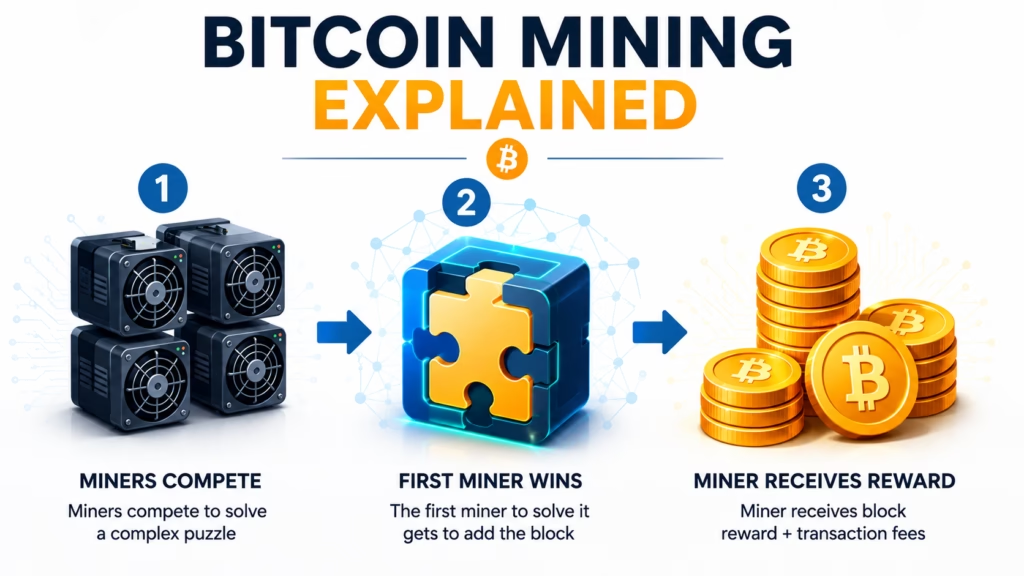
Miners collect verified transactions into a candidate block and compete to solve a complex mathematical puzzle.
The first miner to solve it earns the right to add the block to the blockchain.
As compensation for providing computing power and electricity, the successful miner receives:
- Newly created Bitcoin (block reward)
- Transaction fees included in that block
This reward system encourages miners around the world to continue securing the network.
Why Does Bitcoin Need Mining?
Imagine a football match without referees.
Players could argue endlessly about goals, fouls, and the final score.
Mining acts as one of the mechanisms that helps the Bitcoin network agree on which transactions are valid and in what order they should be recorded.
It provides security, prevents fraudulent transaction histories, and makes rewriting past records extremely expensive.
What Is a Bitcoin Wallet?
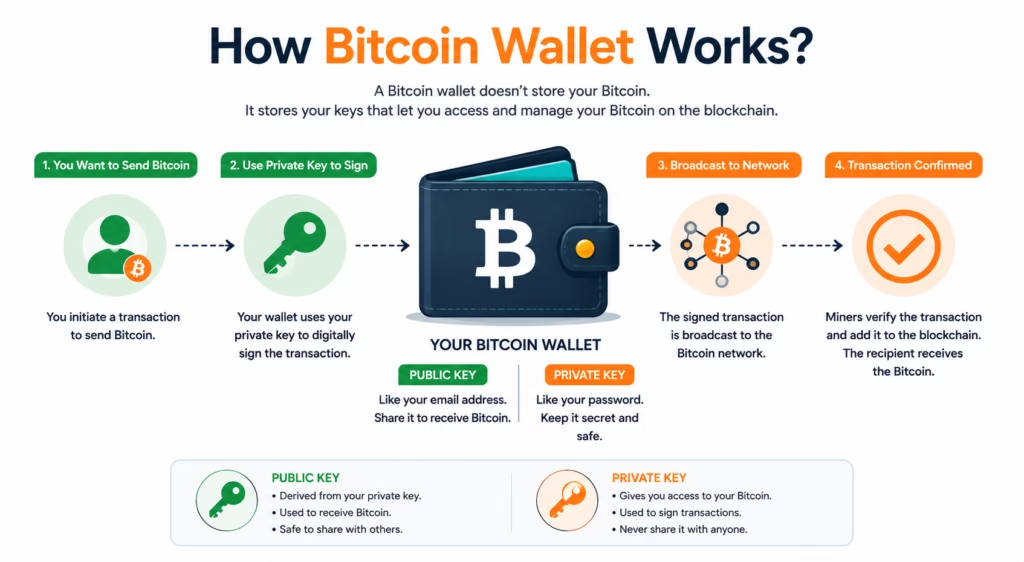
A Bitcoin wallet does not actually store Bitcoin.
This surprises many beginners.
Your Bitcoin always exists on the blockchain.
The wallet simply stores the cryptographic keys that allow you to access and spend your Bitcoin.
A useful analogy is email.
Your emails are stored on servers—not inside your phone.
Your email app simply allows you to access your inbox.
Similarly, a Bitcoin wallet gives you access to your Bitcoin on the blockchain.
Types of Bitcoin Wallets
Hot Wallets
Hot wallets remain connected to the internet.
Examples include:
- Mobile wallets
- Desktop wallets
- Web wallets
Advantages:
- Quick access
- Easy to use
- Suitable for everyday transactions
Disadvantages:
- Greater exposure to online threats
Cold Wallets
Cold wallets remain offline most of the time.
Examples include:
- Hardware wallets
- Paper backups
Advantages:
- Stronger protection against online attacks
- Better suited for long-term storage
Disadvantages:
- Slightly less convenient for frequent transactions
Public Key vs Private Key
Every Bitcoin wallet contains two important components.
Public Key
Think of it as your bank account number.
You can safely share it with others so they can send you Bitcoin.
Private Key
Think of it as the master key to your house.
Anyone who obtains your private key can control your Bitcoin.
It should never be shared.
Keeping private keys secure is one of the most important responsibilities for every Bitcoin holder.
Seed Phrase
When creating a wallet, users usually receive a recovery phrase consisting of 12 or 24 words.
This is called a seed phrase.
It acts as the master backup for the wallet.
If a phone or hardware wallet is lost, the seed phrase can restore access to the funds.
However, anyone who gains access to the seed phrase can also gain access to the associated Bitcoin.
For this reason, it should be stored securely and never shared online.
Key Takeaways
Before moving to Bitcoin’s economics and value, remember these points:
- Bitcoin transactions are verified by a decentralized network.
- Blockchain acts as a permanent public ledger.
- Nodes verify the rules.
- Miners secure the network and create new blocks.
- Wallets store cryptographic keys—not the Bitcoin itself.
- Private keys and seed phrases must always remain confidential.
Why Does Bitcoin Have Value?
One of the first questions beginners ask is:
“If Bitcoin isn’t issued by a government and doesn’t exist physically, why do people consider it valuable?”
The answer is not based on a single reason. Bitcoin’s value comes from a combination of technology, economics, market demand, and growing global adoption.
Just as gold derives value from its scarcity, durability, and widespread acceptance, Bitcoin’s value is supported by characteristics that many investors and institutions consider unique.
Let’s explore the factors that contribute to its value.
1. Limited Supply
The most well-known feature of Bitcoin is its fixed supply.
Unlike traditional currencies, which governments can issue in larger quantities, Bitcoin’s supply is permanently capped at 21 million coins.
This limit is built directly into Bitcoin’s software.
No central bank, government, company, or developer can simply decide to create more Bitcoin.
Because supply cannot expand indefinitely, many people describe Bitcoin as a scarce digital asset.
2. Decentralization
Bitcoin operates without a central authority.
No single company processes transactions.
No government controls issuance.
No CEO can change the monetary policy.
Instead, thousands of participants collectively maintain the network.
Supporters argue that this decentralized structure makes Bitcoin resistant to censorship and reduces dependence on a single institution.
3. Security
Bitcoin has operated continuously since 2009.
Over the years, its network has become one of the most secure public blockchain systems in existence.
Its security comes from:
- Distributed network participants
- Cryptography
- Consensus rules
- Continuous verification by nodes
- Mining competition
It is important to distinguish between the Bitcoin protocol and third-party services.
While exchanges or individual wallets may be hacked, that does not necessarily mean the Bitcoin network itself has been compromised.
4. Global Accessibility
Anyone with an internet connection and a compatible wallet can participate in the Bitcoin network, regardless of geographic location.
This global accessibility has contributed to Bitcoin’s adoption across different countries and economic systems.
For some users, Bitcoin represents a payment network.
For others, it serves as a long-term store of value.
5. Institutional Adoption
During Bitcoin’s early years, participation came primarily from technology enthusiasts and individual investors.
Today, the landscape has evolved.
Financial institutions, investment firms, publicly traded companies, and asset managers have increasingly explored Bitcoin through regulated investment products, custody services, treasury strategies, and research initiatives.
Institutional participation does not guarantee future price performance, but it has increased Bitcoin’s visibility within the broader financial system.
The 21 Million Bitcoin Supply
Bitcoin’s supply is one of its defining characteristics.
The protocol specifies that no more than 21 million bitcoins can ever exist.
New Bitcoin enters circulation through mining rewards.
However, these rewards do not remain constant forever.
Instead, they gradually decrease through an event known as the Bitcoin Halving.
What Is Bitcoin Halving?
Approximately every four years, the reward paid to miners for adding a new block is reduced by half.
This scheduled event is known as Bitcoin Halving.
Its purpose is to slow the rate at which new Bitcoin enters circulation.
As issuance decreases over time, Bitcoin becomes increasingly scarce.
Historically, halving events have attracted significant attention from investors and analysts because they influence Bitcoin’s long-term supply dynamics.
However, halving alone does not determine future prices.
Market conditions, demand, regulation, and broader economic factors also play important roles.
Advantages of Bitcoin
Bitcoin offers several characteristics that distinguish it from many traditional payment systems.
Global Transactions
Bitcoin can be transferred across borders without requiring traditional banking infrastructure.
Transparent Ledger
Every confirmed transaction becomes part of the public blockchain, allowing anyone to independently verify network activity.
Limited Monetary Supply
The fixed supply model prevents unlimited creation of new coins.
Decentralized Network
No single institution controls the entire system.
High Liquidity
Bitcoin is traded on numerous regulated and unregulated exchanges worldwide, making it one of the most actively traded digital assets.
Risks of Bitcoin
While Bitcoin offers unique features, it also carries significant risks that every beginner should understand.
Price Volatility
Bitcoin’s price can change significantly over short periods.
Large upward and downward movements are common.
Because of this volatility, investors should understand the risks before participating.
Regulatory Changes
Cryptocurrency regulations differ between countries and continue evolving.
New laws or policy decisions may affect trading, taxation, reporting requirements, or market access.
Security Responsibility
Unlike traditional banking systems, Bitcoin users are generally responsible for protecting their own wallets and recovery information.
Losing access to private keys or recovery phrases may result in permanent loss of access to funds.
Scams
The cryptocurrency industry has attracted fraudulent schemes such as fake investment platforms, phishing attacks, impersonation scams, and unrealistic profit promises.
Users should verify information carefully before making financial decisions.
Common Myths About Bitcoin
Myth 1 — Bitcoin Is Anonymous
Not exactly.
Bitcoin transactions are recorded on a public blockchain.
Although wallet addresses are not directly linked to personal identities, blockchain transactions remain publicly visible.
For this reason, Bitcoin is more accurately described as pseudonymous, not completely anonymous.
Myth 2 — Bitcoin Is Illegal Everywhere
False.
The legal status of Bitcoin varies from one jurisdiction to another.
Some countries regulate it, others restrict certain activities, while some have adopted more supportive regulatory frameworks.
Readers should always check the current laws applicable in their own country.
Myth 3 — Bitcoin Has No Real Value
Supporters argue that Bitcoin derives value from scarcity, security, network participation, utility, and market demand.
Critics disagree.
Like many financial assets, Bitcoin’s market value ultimately depends on what participants are willing to pay under prevailing market conditions.
Bitcoin vs Gold
| Feature | Bitcoin | Gold |
|---|---|---|
| Form | Digital | Physical |
| Supply | Fixed at 21 million | Naturally limited but expandable through mining |
| Transfer | Minutes (network conditions may vary) | Physical transportation or financial intermediaries |
| Storage | Digital wallets | Physical vaults or custodians |
| Verification | Blockchain | Physical testing and certification |
Both assets are viewed differently by different investors.
Neither should automatically be considered superior in every situation.
Real-World Uses of Bitcoin
Bitcoin is used in several ways today.
Examples include:
- Cross-border payments
- Long-term investment strategies
- Portfolio diversification
- Treasury holdings by some companies
- Financial education
- Academic research into blockchain technology
Adoption continues to evolve as technology, regulation, and financial markets develop.
Key Takeaways
Before moving to the final section, remember these important points:
Understanding Bitcoin is more important than following market hype.
Bitcoin’s value comes from multiple factors, not a single feature.
Scarcity alone does not determine price.
Bitcoin offers opportunities but also carries risks.
Regulations vary by country.
Frequently Asked Questions
Is Bitcoin legal?
Bitcoin’s legal status depends on the country. Some countries allow ownership and trading under specific regulations, while others impose restrictions. Always check the latest laws applicable in your jurisdiction before buying or using Bitcoin.
Can Bitcoin be hacked?
The Bitcoin network itself has remained highly secure since its launch in 2009. However, cryptocurrency exchanges, wallets, or user accounts may be compromised if proper security practices are not followed.
Who controls Bitcoin?
No single government, company, or individual controls Bitcoin. The network operates through open-source software and is maintained by thousands of independent participants worldwide.
Can Bitcoin transactions be reversed?
Generally, no.
Once a Bitcoin transaction receives sufficient network confirmations, it cannot be reversed. This is why users should carefully verify wallet addresses before sending funds.
How many Bitcoins will ever exist?
Bitcoin has a maximum supply of 21 million coins, a limit built into the protocol.
What happens if I lose my wallet?
If you still have your recovery (seed) phrase, you can restore your wallet.
If both your wallet and recovery phrase are lost, access to your Bitcoin may be permanently lost.
Is Bitcoin anonymous?
Bitcoin is better described as pseudonymous rather than anonymous. Transactions are publicly recorded on the blockchain, although wallet addresses are not directly tied to personal identities.
Why is Bitcoin so volatile?
Bitcoin’s price is influenced by market demand, investor sentiment, macroeconomic conditions, regulatory developments, and liquidity. These factors can lead to significant price fluctuations over short periods.
Can governments ban Bitcoin?
Governments can regulate exchanges, taxation, and cryptocurrency-related businesses within their jurisdictions. However, the decentralized Bitcoin network itself is distributed globally.
Should beginners invest in Bitcoin?
Understanding Bitcoin and investing in Bitcoin are two different things.
Before making any financial decision, beginners should first understand how Bitcoin works, the risks involved, and the regulations applicable in their country.
Common Mistakes Beginners Make
Many new users enter the cryptocurrency market without fully understanding how Bitcoin works. Avoiding these common mistakes can reduce unnecessary risk.
Investing Without Understanding the Technology
Buying an asset without understanding its fundamentals often leads to emotional decisions during periods of market volatility.
Ignoring Wallet Security
Failing to protect private keys or recovery phrases is one of the most common causes of cryptocurrency loss.
Believing Every Social Media Prediction
Social media often contains exaggerated claims, unrealistic price targets, and misinformation. Always verify important information through trusted sources.
Chasing Quick Profits
Bitcoin is frequently discussed during periods of rapid price movement, but making decisions based solely on hype can expose investors to unnecessary risk.
Skipping Personal Research
Independent research remains one of the most valuable habits for anyone entering the cryptocurrency market.
What Should You Learn Next?
Understanding Bitcoin is only the first step.
If you want to build a deeper understanding of cryptocurrency, consider exploring these topics next:
- Blockchain Explained
- How Bitcoin Wallets Work
- What Is Bitcoin Mining?
- How Bitcoin Transactions Work
- What Is A Bitcoin Address?
- Bitcoin Halving Explained
- What Is Ethereum?
- Public Key vs Private Key
- Cryptocurrency Security Best Practices
These topics build naturally on the concepts introduced in this guide.
Final Thoughts
Bitcoin introduced a new way of thinking about digital money by combining cryptography, distributed computing, and economic incentives into a decentralized payment network.
Whether Bitcoin ultimately becomes a global payment system, a digital store of value, or continues evolving in new ways remains a subject of ongoing discussion among economists, technologists, regulators, and investors.
For beginners, however, the most important goal is not to predict Bitcoin’s future price—it is to understand the technology, the opportunities, and the risks before making any financial decisions.
A solid understanding of Bitcoin provides a strong foundation for learning about blockchain technology, digital assets, and the rapidly changing world of modern finance.
Disclaimer
This article is published for educational and informational purposes only. It should not be interpreted as financial, investment, legal, or tax advice.
Cryptocurrency markets involve significant risks, including the potential loss of capital. Readers should conduct their own research and consult qualified financial or legal professionals before making investment decisions.
Editorial Information
Category: Crypto
Subcategory: Bitcoin
Article Type: Evergreen Educational Guide
Difficulty Level: Beginner
Estimated Reading Time: 12–15 Minutes