

Introduction of Bitcoin Mining Explained
When most people hear the word mining, they imagine workers digging gold, coal, or diamonds out of the ground.
Bitcoin mining is completely different.
No one is digging digital coins out of the internet.
Instead, Bitcoin mining is a process where specialized computers verify transactions, secure the Bitcoin network, and compete to add new blocks to the blockchain. As a reward for performing this work, successful miners receive newly created Bitcoin along with transaction fees.
Without miners, the Bitcoin network would not be able to process transactions or maintain its decentralized security.
Understanding Bitcoin mining is essential because it explains:
- How new Bitcoins enter circulation.
- Why Bitcoin transactions are secure.
- Why Bitcoin has a limited supply.
- Why mining requires powerful computers.
- Why the Bitcoin network continues operating without a central authority.
Whether you’re curious about cryptocurrency or simply want to understand how Bitcoin functions behind the scenes, this guide explains the entire process step by step.
Quick Summary
If you’re completely new to Bitcoin mining, remember these key points:
- Bitcoin mining is not digging digital coins.
- Miners verify and confirm Bitcoin transactions.
- Verified transactions are grouped into blocks.
- Miners compete to solve a cryptographic puzzle.
- The winning miner adds the next block to the blockchain.
- Successful miners receive a block reward and transaction fees.
- Mining helps secure the Bitcoin network.
💡 Key Takeaway
Bitcoin mining is the process that verifies transactions, secures the blockchain, and introduces new Bitcoin into circulation according to Bitcoin’s protocol.
What Is Bitcoin Mining?
Bitcoin mining is the process of validating transactions and adding new blocks to the Bitcoin blockchain through a consensus mechanism known as Proof of Work (PoW).
Specialized computers called miners perform complex calculations in an attempt to solve a cryptographic puzzle.
The first miner to find a valid solution earns the opportunity to add the next block to the blockchain.
In return, the miner receives:
- Newly issued Bitcoin (block reward).
- Transaction fees included in that block.
This reward encourages miners around the world to contribute computing power that helps secure the Bitcoin network.
Why Does Bitcoin Need Mining?
Imagine a digital payment system with no bank, no company, and no central server.
Who checks whether a transaction is genuine?
Who prevents someone from spending the same Bitcoin twice?
Who updates the ledger fairly?
Bitcoin solves these challenges through mining.
Instead of trusting a single organization, thousands of independent miners compete to verify transactions according to the same protocol rules.
This decentralized approach removes the need for a central authority while helping keep the network secure.
The Three Main Purposes of Mining
Bitcoin mining performs three essential functions.
1. Verify Transactions
Before a transaction becomes permanent, miners help verify that it follows Bitcoin’s rules.
For example:
- Does the sender control the Bitcoin being spent?
- Has the Bitcoin already been spent elsewhere?
- Is the digital signature valid?
Only valid transactions can be included in a new block.
2. Secure the Network
Mining makes it extremely difficult for malicious actors to rewrite Bitcoin’s transaction history.
Because thousands of miners compete using substantial computational resources, changing confirmed blockchain history becomes increasingly impractical as more blocks are added.
3. Issue New Bitcoin
Mining is also the mechanism through which new Bitcoin enters circulation.
Unlike traditional currencies, which may be issued by central banks, Bitcoin follows predetermined protocol rules.
New Bitcoin is created only as part of the mining reward and the total supply is capped at 21 million BTC.
📌 Did You Know?
No one—not governments, companies, or even Bitcoin’s creator—can arbitrarily create additional Bitcoin beyond the protocol’s maximum supply.
Who Are Bitcoin Miners?
A Bitcoin miner is an individual or organization that contributes computing power to help process transactions and secure the Bitcoin network.
Modern mining typically uses specialized machines known as ASICs (Application-Specific Integrated Circuits).
These devices are designed specifically for Bitcoin mining and are significantly more efficient than general-purpose computers.
Mining today ranges from:
- Individual hobbyists.
- Professional mining companies.
- Large-scale mining facilities operating thousands of ASIC machines.
Regardless of size, every miner follows the same protocol rules.
Mining Is Like a Lottery
One of the easiest ways to understand mining is to compare it to a lottery.
Imagine millions of people each trying different combinations to unlock a digital safe.
Everyone follows the same rules.
No one knows in advance which attempt will succeed.
Eventually, one participant finds the correct combination.
That participant wins the right to add the next block and receives the mining reward.
Then the competition immediately starts again for the next block.
This analogy isn’t perfect, but it helps explain why mining is competitive and why increasing computing power generally improves a miner’s chances over time.
⚠ Common Mistake
Many beginners believe that miners create Bitcoin out of thin air whenever they want.
This is incorrect.
The Bitcoin protocol strictly controls:
- When new Bitcoin is issued.
- How much Bitcoin is awarded.
- The maximum supply of Bitcoin.
- The rules miners must follow to receive rewards.
Miners cannot change these rules on their own.
Why Is Mining Competitive?
Every miner wants to receive the block reward.
However, only one miner (or mining pool) can successfully produce the next valid block at a given time.
As more miners join the network:
- Competition increases.
- The network adjusts mining difficulty over time to help maintain Bitcoin’s target average block interval of about 10 minutes.
This adjustment helps keep Bitcoin operating predictably despite changes in total network computing power.
Real-Life Analogy
Imagine thousands of people trying to guess the correct six-digit lock combination.
The first correct guess opens the lock and wins the prize.
Bitcoin mining follows a similar concept, except miners use specialized computers to perform enormous numbers of cryptographic calculations each second.
How Does Bitcoin Mining Work?
Now that you know why Bitcoin mining exists, let’s see what actually happens behind the scenes.
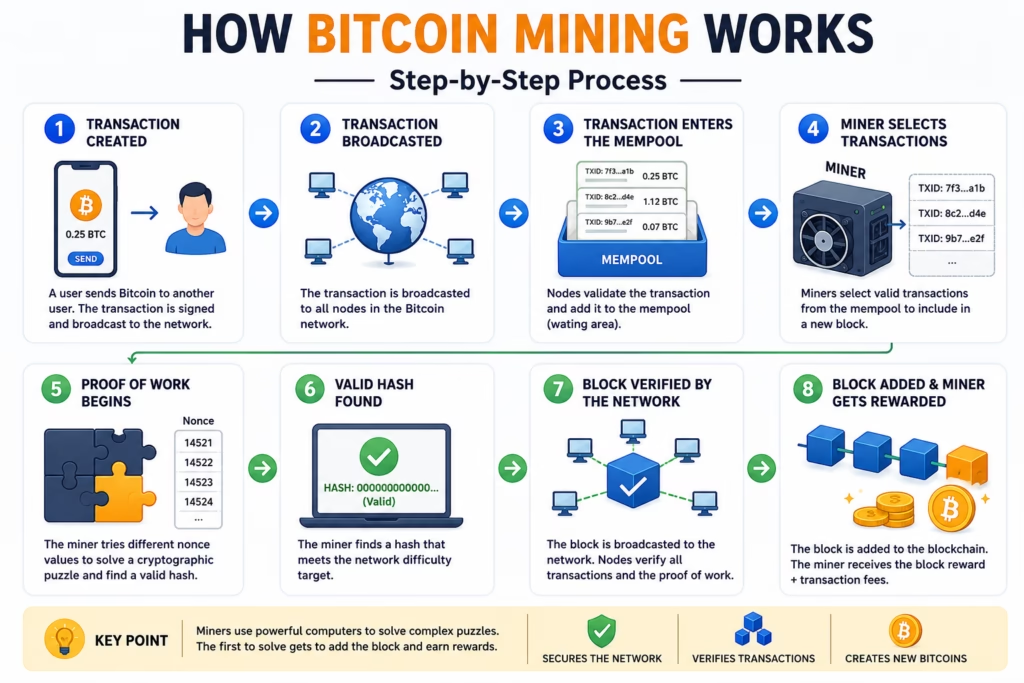
Although mining involves advanced cryptography and powerful computers, the overall process follows a clear sequence of steps.
Step 1 — Users Create Transactions
Every Bitcoin transaction begins when someone sends Bitcoin to another person.
For example:
- Alice wants to send 0.25 BTC to Bob.
- Alice enters Bob’s Bitcoin address in her wallet.
- Her wallet creates the transaction.
- The wallet signs the transaction using Alice’s private key.
At this stage, the transaction has been created but is not yet part of the blockchain.
Instead, it is broadcast to the Bitcoin network.
Step 2 — Transactions Enter the Mempool
Once broadcast, the transaction reaches thousands of Bitcoin nodes.
Valid transactions are placed into a temporary waiting area called the mempool (memory pool).
Think of the mempool as a queue.
Every new transaction waits there until a miner selects it for inclusion in a block.
When the network is busy, the mempool may contain thousands of pending transactions.
📌 Did You Know?
Miners often prioritize transactions offering higher network fees because those fees become part of the mining reward.
Step 3 — Miners Collect Transactions
Each miner builds a candidate block by selecting valid transactions from the mempool.
A block contains:
- A list of verified transactions
- A timestamp
- A reference (hash) to the previous block
- Additional metadata required by the Bitcoin protocol
At this point, the block has not yet been accepted by the network.
The miner must first solve a cryptographic challenge.
Step 4 — Proof of Work Begins
This is where Bitcoin mining becomes competitive.
Each miner repeatedly performs calculations while changing a value called the nonce.
The goal is to produce a block hash that satisfies the network’s current difficulty requirement.
There is no shortcut.
Miners simply try enormous numbers of possible values until one produces a valid result.
This process is called Proof of Work (PoW).
What Is Proof of Work?
Proof of Work is the consensus mechanism that allows the Bitcoin network to agree on which block should be added next.
Instead of trusting a central authority, the network requires miners to demonstrate that they have performed significant computational work.
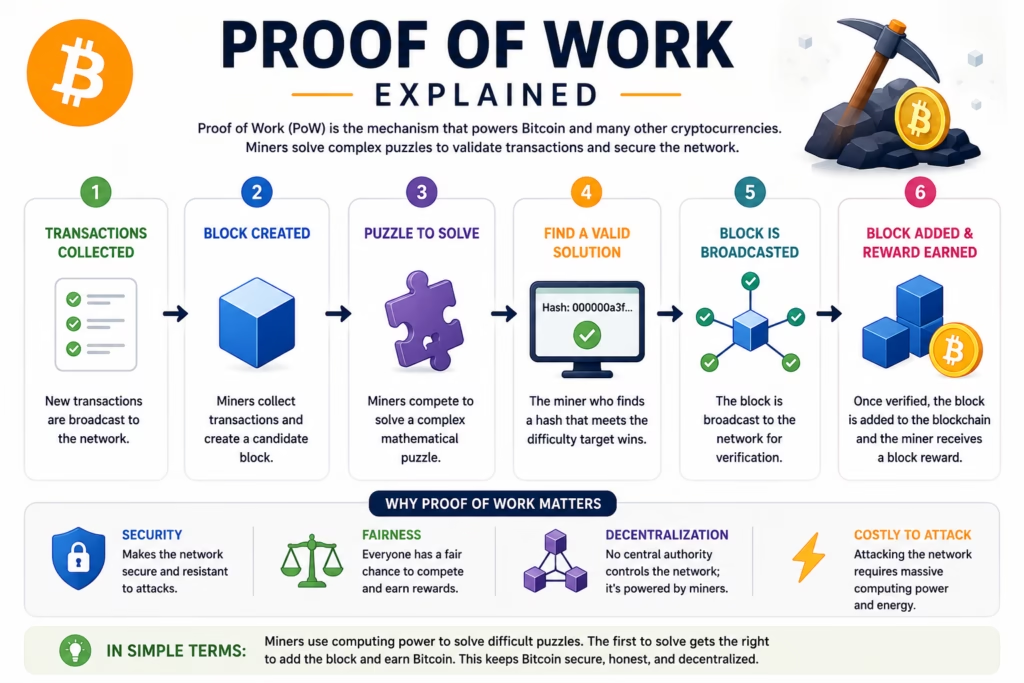
Finding a valid solution requires effort.
Checking that solution, however, is relatively quick for other nodes.
This balance helps make Bitcoin secure.
Real-Life Analogy
Imagine a giant lottery with millions of participants.
Every second, each participant receives millions of lottery tickets.
Eventually, one participant receives the winning ticket.
That participant earns the prize.
Bitcoin mining works similarly.
The more computing power a miner contributes, the more attempts they can make—but success is never guaranteed.
💡 Key Takeaway
Proof of Work is not about solving useful math problems.
It is about proving that computational work was performed according to Bitcoin’s protocol rules.
What Is a Hash?
A hash is a fixed-length string of characters generated by a cryptographic hash function.
In Bitcoin, miners repeatedly calculate hashes while trying to discover one that satisfies the required difficulty target.
Even a tiny change to the block data produces a completely different hash.
For example:
Input A

Bitcoin

↓

Hash

6b3a55e0261b0304143f805a2496c...

Input B

bitcoin

↓

Hash

8f434346648f6b96df89dda901c...
Notice that changing just one letter completely changes the output.
This property is one of the reasons blockchain data is difficult to tamper with.
What Is a Nonce?
A nonce is a number that miners repeatedly change while searching for a valid block hash.
Each time the nonce changes, the resulting hash also changes.
Miners continue testing new nonce values until one produces a hash that meets the current difficulty requirement.
Millions—or even trillions—of attempts may be needed before success.
Think of It Like a Combination Lock
Imagine trying to unlock a safe without knowing the correct combination.
You keep entering different combinations until one finally works.
The nonce is similar.
Miners keep changing it until the block produces a valid hash.
Step 5 — A Miner Finds the Winning Hash
Eventually, one miner discovers a hash that satisfies the Bitcoin network’s difficulty target.
The miner immediately broadcasts the completed block to the network.
This does not mean the block is accepted automatically.
Other Bitcoin nodes independently verify:
- The block follows Bitcoin’s rules.
- Every included transaction is valid.
- The Proof of Work is correct.
- The block references the correct previous block.
Only after successful verification is the block accepted.
Step 6 — The Blockchain Is Updated
Once verified, the block is added to the blockchain.
The transactions inside that block become confirmed.
Wallet balances update automatically as software reads the latest blockchain data.
The mining reward is assigned according to the protocol, and the competition begins again for the next block.
This cycle repeats continuously, helping the Bitcoin network remain decentralized and operational around the clock.
Bitcoin Mining Process
User Creates Transaction
          │
          ▼
Transaction Broadcast
          │
          ▼
Mempool
          │
          ▼
Miner Selects Transactions
          │
          ▼
Proof of Work
          │
          ▼
Valid Hash Found
          │
          ▼
Block Verified
          │
          ▼
Block Added to Blockchain
          │
          ▼
Miner Receives Reward
Why Do Confirmations Matter?
When a block is added to the blockchain, the transactions inside receive their first confirmation.
Each additional block added afterward increases the number of confirmations.
More confirmations generally make reversing a transaction increasingly impractical because altering earlier blocks would require redoing the computational work for subsequent blocks while competing with the rest of the network.
⚠ Common Mistake
Many beginners think miners verify only their own transactions.
In reality, miners compete to verify transactions submitted by users across the Bitcoin network while following the same protocol rules.
Block Rewards: How Miners Earn Bitcoin
Mining requires expensive hardware, electricity, and continuous maintenance.
To encourage people to contribute computing power, the Bitcoin protocol rewards successful miners.
A miner who adds a valid block to the blockchain can receive two types of rewards:
- Block Reward (newly issued Bitcoin)
- Transaction Fees paid by users whose transactions are included in the block
Together, these rewards provide the economic incentive that helps keep the Bitcoin network operating.
What Is a Block Reward?
Every time a valid block is added to the Bitcoin blockchain, the protocol creates a predetermined amount of new Bitcoin.
This newly created Bitcoin is known as the block reward.
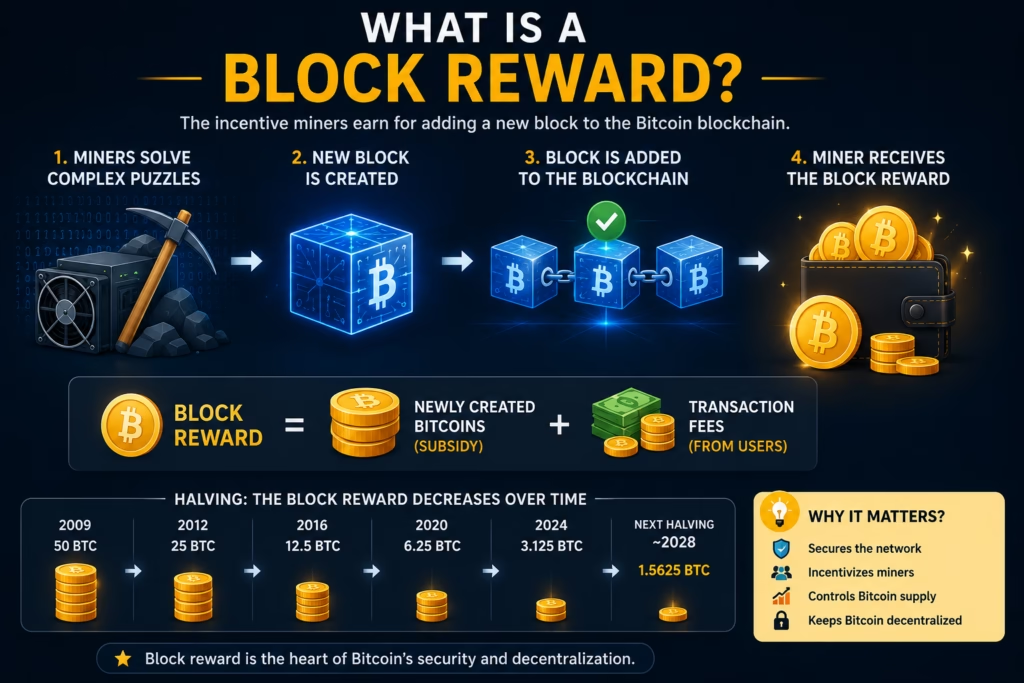
Unlike traditional currencies, where a central bank can adjust the money supply, Bitcoin follows transparent protocol rules that determine exactly how new coins are introduced.
The block reward decreases over time through an event called the Bitcoin Halving.
What Are Transaction Fees?
Whenever someone sends Bitcoin, they usually include a transaction fee.
These fees are not paid to Bitcoin itself or to a company.
Instead, they are collected by the miner who successfully includes that transaction in a confirmed block.
During periods of high network activity, users may choose to pay higher fees to increase the likelihood of faster confirmation.
As block rewards continue to decrease over time, transaction fees are expected to play an increasingly important role in miner revenue.
💡 Key Takeaway
Bitcoin miners are rewarded through a combination of newly issued Bitcoin and transaction fees, creating incentives that support the security of the network.
What Is Bitcoin Halving?
Bitcoin was designed with a fixed maximum supply of 21 million coins.
To control the rate at which new Bitcoin enters circulation, the protocol includes a mechanism known as Bitcoin Halving.
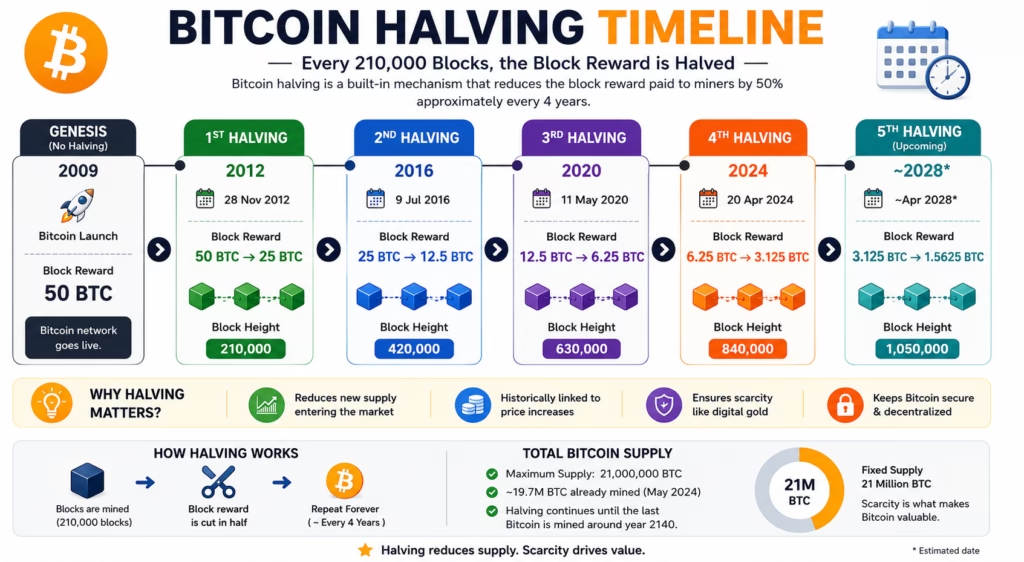
Approximately every 210,000 blocks (roughly every four years), the block reward is reduced by half.
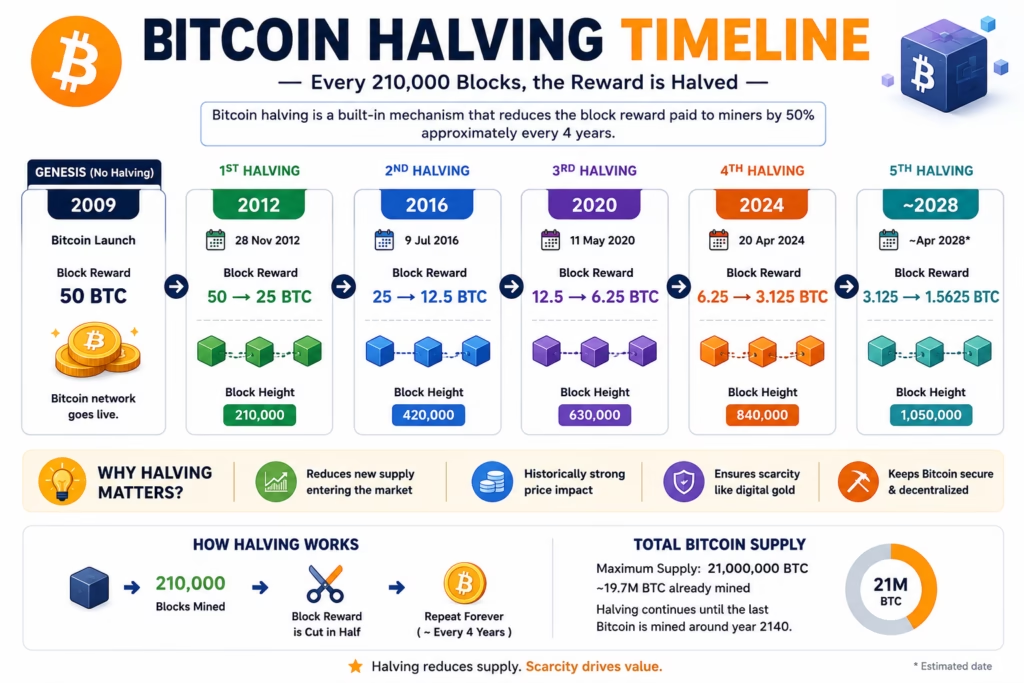
For example:
- The earliest miners received much larger block rewards.
- Over time, the reward has decreased according to the protocol’s schedule.
- This process continues until the issuance of new Bitcoin eventually reaches zero.
The exact timing depends on when blocks are mined, so the interval is approximate rather than tied to a calendar date.
Why Is Halving Important?
Halving slows the creation of new Bitcoin.
Supporters argue that this increasing scarcity is one of Bitcoin’s defining characteristics.
However, halving alone does not determine Bitcoin’s future price.
Market demand, regulation, adoption, macroeconomic conditions, and many other factors also influence price.
📌 Did You Know?
The last Bitcoin is expected to be mined around the year 2140, after which miners are expected to rely primarily on transaction fees for compensation.
What Is Mining Difficulty?
Imagine only 100 miners are participating.
Finding the next block would become relatively easy.
Now imagine millions of miners join the network.
Without adjustment, blocks would be found much more quickly than intended.
Bitcoin solves this through mining difficulty adjustment.
The protocol periodically adjusts the difficulty target so that the average time between blocks remains close to 10 minutes, regardless of changes in total network computing power.
This helps keep Bitcoin’s issuance schedule relatively predictable.
What Is an ASIC Miner?
In Bitcoin’s early years, mining could be performed using ordinary computers.
As competition increased, more specialized hardware became necessary.
Today, professional Bitcoin mining is typically performed using ASICs (Application-Specific Integrated Circuits).
ASIC miners are designed specifically for Bitcoin’s mining algorithm and are significantly more efficient than general-purpose CPUs or GPUs for this task.
Can You Mine Bitcoin at Home?
Technically, yes.
Practically, it depends on several factors.
These include:
- Electricity costs
- Hardware efficiency
- Mining difficulty
- Equipment cost
- Cooling requirements
- Local regulations
Many individual miners now participate through mining pools, where participants combine computing power and share rewards according to their contribution.
Whether home mining is economically viable varies over time and depends on individual circumstances.
⚠ Common Mistake
Many beginners believe they can install software on a laptop and earn significant Bitcoin.
Modern Bitcoin mining is highly competitive, and profitability depends on many factors beyond simply running mining software.
Does Bitcoin Mining Harm the Environment?
Bitcoin mining’s energy use has been the subject of ongoing discussion.
Different researchers, companies, and policymakers have reached different conclusions regarding its environmental impact.
Some important considerations include:
- Energy consumption varies across mining operations.
- Some miners use renewable or otherwise lower-carbon energy sources.
- Others rely on conventional electricity grids.
- Improvements in hardware efficiency continue over time.
The topic remains an area of active research and public debate.
Readers interested in this issue should consult multiple reputable sources rather than relying on a single viewpoint.
Common Myths About Bitcoin Mining
Myth 1 — Bitcoin Is Created Out of Thin Air
Not exactly.
New Bitcoin is issued only according to the protocol’s predetermined rules and only through the mining reward.
Myth 2 — Mining Means Digging Digital Coins
Mining is a computational process that validates transactions and secures the blockchain.
No digital coins are physically extracted.
Myth 3 — Anyone Can Easily Mine Bitcoin on a Laptop
Modern Bitcoin mining generally requires specialized hardware and competitive operating costs.
Myth 4 — Mining Is Only About Earning Bitcoin
Mining also performs the essential function of securing the Bitcoin network and validating transactions.
Without miners, Bitcoin could not operate as designed.
Frequently Asked Questions
What is Bitcoin mining?
Bitcoin mining is the process of validating transactions, adding new blocks to the blockchain, and securing the Bitcoin network using the Proof of Work consensus mechanism.
Why do miners receive rewards?
Rewards encourage miners to contribute computing power that helps verify transactions and secure the network.
Can Bitcoin exist without mining?
Under Bitcoin’s current design, mining is a fundamental part of how new blocks are created and transactions are confirmed.
How long does it take to mine one Bitcoin?
Individual miners do not typically mine an entire Bitcoin at once.
Mining rewards are distributed according to the protocol, and many miners participate in mining pools where rewards are shared.
What is a mining pool?
A mining pool is a group of miners who combine computing power and share rewards based on each participant’s contribution.
Is Bitcoin mining legal?
The legal status of Bitcoin mining varies by country and jurisdiction.
Readers should review the laws applicable where they live.
What equipment is used for Bitcoin mining?
Professional mining is primarily performed using specialized ASIC hardware designed specifically for Bitcoin’s mining algorithm.
What Should You Learn Next?
Now that you understand Bitcoin mining, continue learning with:
- What Is Bitcoin?
- What Is Blockchain?
- How Bitcoin Wallets Work
- How Bitcoin Transactions Work
- What Is A Bitcoin Address?
- Bitcoin Halving Explained
- Public Key vs Private Key
- Bitcoin Transactions Explained
- Bitcoin Security Guide
Final Thoughts
Bitcoin mining is much more than the process through which new Bitcoin enters circulation.
It is the mechanism that helps verify transactions, secures the blockchain, and enables a decentralized payment network to operate without a central authority.
Although the underlying technology is complex, its purpose is straightforward: create a trustworthy system where participants can agree on the state of the ledger without relying on a single organization.
Understanding mining also helps explain many of Bitcoin’s defining characteristics, including its limited supply, predictable issuance schedule, and network security.
Whether you plan to invest in Bitcoin or simply want to understand how it works, learning about mining is an essential step in understanding the broader Bitcoin ecosystem.
Disclaimer
This article is published for educational and informational purposes only.
It does not constitute financial, investment, legal, or tax advice.
Readers should verify important information through official sources and consult qualified professionals before making financial decisions.
References
Review and verify information against primary sources such as:
- Bitcoin: A Peer-to-Peer Electronic Cash System (Satoshi Nakamoto, 2008)
- Bitcoin.org
- Bitcoin Core Documentation
- Bitcoin Developer Documentation
- Cambridge Centre for Alternative Finance
- Relevant Bitcoin Improvement Proposals (BIPs)