

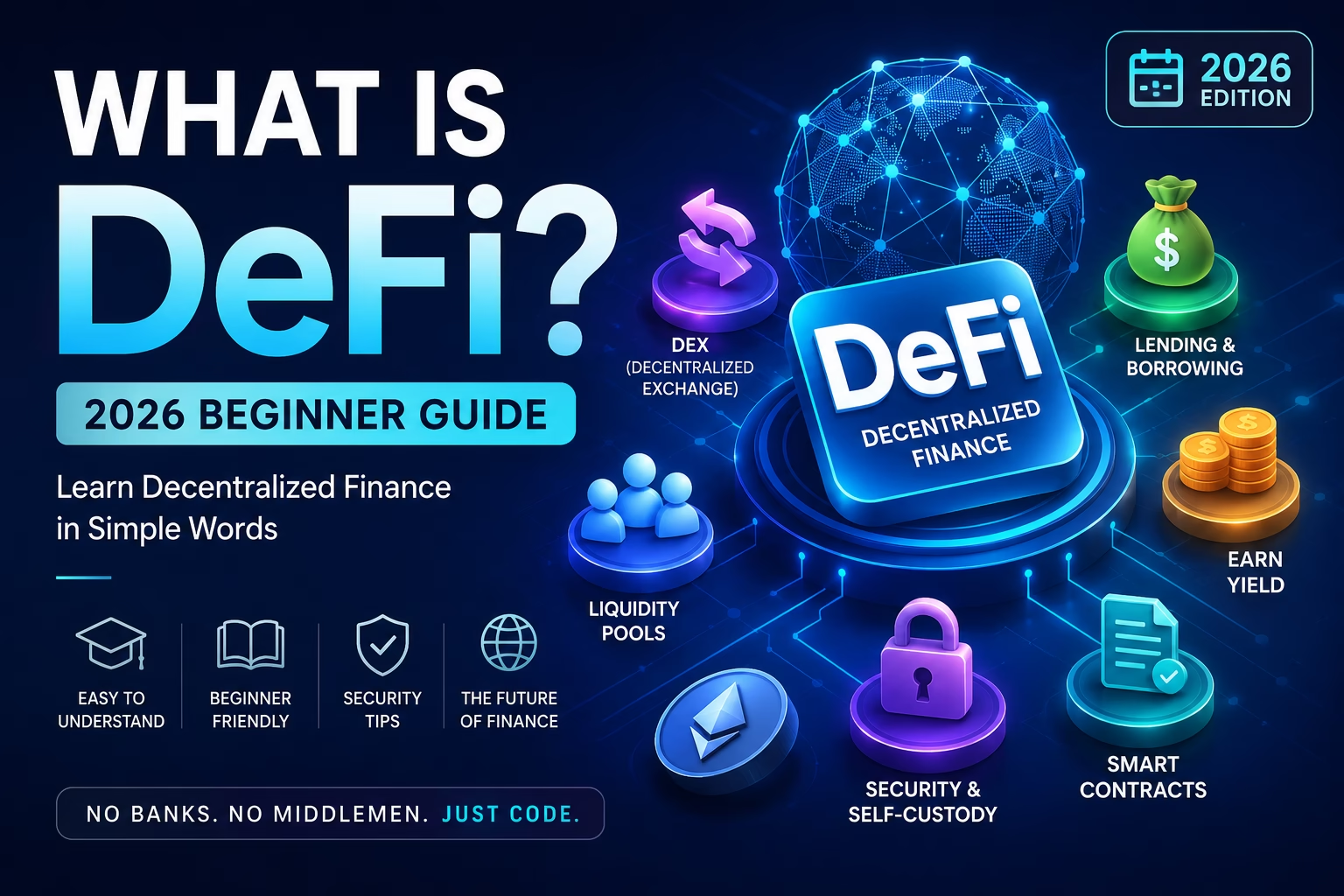
Introduction
Imagine being able to borrow money, earn interest on your savings, exchange currencies, or send funds to someone on the other side of the world—all without visiting a bank, filling out paperwork, waiting for business hours, or relying on a financial intermediary.
For many people, this sounds like something from the future.
Yet today, blockchain technology has made it possible to build financial applications that operate without traditional banks. This new approach is known as Decentralized Finance, commonly shortened to DeFi.
DeFi has become one of the most significant innovations in the cryptocurrency ecosystem. It enables developers to create financial services that run on blockchain networks using smart contracts instead of centralized institutions.
Instead of opening an account at a bank, users typically interact with decentralized applications (dApps) through a compatible cryptocurrency wallet. These applications can offer services such as exchanging digital assets, lending, borrowing, or participating in other blockchain-based financial activities.
It is important to understand, however, that DeFi is not a replacement for every aspect of traditional finance. It is an alternative approach to providing certain financial services, and it comes with its own advantages, limitations, and risks.
Over the past few years, DeFi has expanded rapidly. Developers have created thousands of decentralized applications, while users around the world have explored new ways to interact with digital assets. At the same time, security incidents, smart contract vulnerabilities, and evolving regulations have highlighted the importance of understanding how these systems work before using them.
Whether you are completely new to cryptocurrency or have already learned about Bitcoin, Ethereum, and stablecoins, understanding DeFi is the next logical step in your blockchain journey.
This guide will explain the concept in clear, beginner-friendly language without assuming any prior technical knowledge.
By the end of this article, you’ll understand:
- What DeFi is
- Why DeFi was created
- How decentralized financial applications work
- The technologies that make DeFi possible
- Common DeFi services
- Advantages and risks
- How DeFi differs from traditional banking
- Why DeFi has become an important part of Web3
Quick Summary
DeFi (Decentralized Finance) refers to financial services built on blockchain technology that use smart contracts to automate certain processes instead of relying on traditional financial intermediaries.
Users typically interact with DeFi applications through cryptocurrency wallets, allowing them to exchange digital assets, lend, borrow, or access other blockchain-based services.
Although DeFi offers increased accessibility and transparency in many situations, it also involves risks such as smart contract vulnerabilities, market volatility, regulatory uncertainty, and user responsibility for securing digital assets.
What Is DeFi?
Decentralized Finance (DeFi) is a collection of blockchain-based financial applications designed to provide financial services without relying solely on centralized institutions such as traditional banks or payment processors.
Rather than depending on a single company or organization to manage every transaction, many DeFi applications use smart contracts—computer programs that automatically execute predefined rules when specific conditions are met.
This automation allows users to interact directly with blockchain-based financial systems.
For example, instead of applying for a loan through a traditional bank, a user may interact with a lending protocol built on a blockchain network. The exact requirements, collateral rules, interest calculations, and repayment conditions depend on the specific protocol.
Similarly, instead of exchanging currencies through a centralized exchange, users may trade supported digital assets using decentralized exchange protocols.
The core idea behind DeFi is to make certain financial services more open, programmable, and interoperable through blockchain technology.
Understanding the Word “Decentralized”
The word decentralized can seem intimidating at first, but the concept is straightforward.
In a traditional financial system, many services depend on a central organization.
Examples include:
- Banks
- Credit card companies
- Payment processors
- Brokerage firms
- Clearing houses
These organizations verify transactions, maintain records, process payments, and enforce operational rules.
In decentralized systems, many of these responsibilities are instead managed by blockchain networks and smart contracts.
This does not mean there are no rules or governance. Instead, many of the operational rules are encoded into software and executed automatically according to the protocol’s design.
Different DeFi projects use different governance models, and some include decentralized communities that vote on proposed protocol changes.
A Real-Life Analogy
Imagine a public library.
In a traditional library, a librarian manually checks books in and out, records borrowing history, and confirms due dates.
Now imagine an advanced self-service library.
You scan your library card, the system verifies your eligibility, records the transaction, updates inventory, and generates a due date automatically.
The rules still exist, but many tasks are performed by software rather than a person.
DeFi follows a similar principle.
Many financial rules that traditionally require manual processing can be encoded into smart contracts that execute automatically when conditions are met.
This analogy is simplified, but it illustrates how automation can reduce reliance on centralized intermediaries.
Why Was DeFi Created?
To understand why DeFi exists, it helps to look at some characteristics of traditional financial systems.
Banks provide valuable services such as:
- Safeguarding deposits
- Processing payments
- Offering loans
- Facilitating investments
- Supporting international transfers
These services play an important role in the global economy.
However, users may also encounter challenges depending on their location, service provider, or financial circumstances.
Examples include:
- Limited banking access
- Restricted business hours
- Cross-border payment delays
- Processing fees
- Eligibility requirements
- Geographic restrictions
- Multiple intermediaries
Blockchain technology introduced a new way to record ownership and transfer value digitally.
Developers then began asking an important question:
Could financial services also be built directly on blockchain networks?
This question led to the development of DeFi.
Instead of creating a new type of bank, developers created programmable financial protocols that allow users to interact directly with blockchain applications.
The Evolution of Financial Technology
Understanding DeFi becomes easier when viewed as part of a broader technological evolution.
Stage 1: Cash
Physical money enabled direct exchange of value.
Stage 2: Banking
Banks provided secure storage, lending, and payment infrastructure.
Stage 3: Online Banking
Financial services became available through websites and mobile applications.
Stage 4: Digital Payments
Payment platforms enabled faster online transactions and international commerce.
Stage 5: Blockchain Technology
Distributed ledgers introduced decentralized record-keeping and digital ownership.
Stage 6: DeFi
Developers began building programmable financial services directly on blockchain networks using smart contracts.
Rather than replacing every previous stage, DeFi represents another step in the ongoing evolution of financial technology.
Traditional Finance vs. DeFi
Although both systems aim to provide financial services, they operate differently.
| Feature | Traditional Finance | DeFi |
|---|---|---|
| Managed By | Financial institutions | Blockchain protocols and smart contracts |
| Availability | Depends on institution and region | Often accessible at any time, subject to network availability |
| Account Access | Bank account required | Compatible crypto wallet typically required |
| Transaction Processing | Institution verifies transactions | Blockchain network validates transactions |
| Transparency | Internal institutional records | Many transactions are publicly verifiable on blockchain explorers |
| Automation | Institution-controlled systems | Smart contract automation |
Neither model is universally better.
Each has strengths and trade-offs depending on the service, regulatory environment, and user needs.
Why Ethereum Became a Foundation for DeFi
Although DeFi applications now exist on multiple blockchain networks, Ethereum played a major role in the growth of decentralized finance.
The reason is simple.
Ethereum introduced programmable smart contracts that allowed developers to create decentralized applications beyond simple value transfers.
This opened the door for:
- Lending platforms
- Decentralized exchanges
- Stablecoins
- NFT marketplaces
- Blockchain games
- Asset tokenization
- Insurance protocols
- Governance systems
Today, DeFi ecosystems also operate on several other blockchain networks, each with its own design goals, transaction costs, performance characteristics, and developer communities.
Did You Know?
The term “money lego” is sometimes used to describe DeFi because many decentralized applications can interact with one another. Developers can build new services by combining existing blockchain protocols, much like assembling structures from compatible building blocks.
Common Myth
Myth: DeFi means there are no rules or regulations.
Reality: DeFi protocols operate according to software-defined rules encoded in smart contracts. In addition, users, developers, and service providers may still be subject to laws and regulations depending on their jurisdiction. The regulatory landscape for digital assets continues to evolve around the world.
Key Takeaways
- DeFi stands for Decentralized Finance.
- It uses blockchain technology and smart contracts to provide financial services.
- Users typically interact with DeFi applications through cryptocurrency wallets.
- DeFi aims to reduce reliance on centralized intermediaries for certain financial activities.
- DeFi offers new opportunities but also introduces technical, operational, and regulatory risks.
- Ethereum played a significant role in the early growth of DeFi, though many blockchain networks now support decentralized financial applications.
How Does DeFi Actually Work?
Now that you understand what DeFi is and why it was created, the next question is obvious:
How can financial services work without a bank?
The answer lies in four technologies working together:
- Blockchain
- Smart Contracts
- Cryptocurrency Wallets
- Decentralized Applications (dApps)
Think of these as four pieces of a machine.
If one piece is missing, the system cannot function properly.
Let’s understand each one step by step.
The Four Building Blocks of DeFi
Imagine ordering food through a mobile app.
Several things happen automatically:
- You place the order.
- The restaurant receives it.
- Payment is verified.
- The kitchen prepares the food.
- A delivery partner is assigned.
- You receive notifications.
- The order is delivered.
There is no single employee manually coordinating every step.
Software automates much of the process.
DeFi follows a similar principle.
Instead of restaurant software, it uses blockchain technology and smart contracts to automate financial activities.
1. Blockchain
Everything begins with the blockchain.
A blockchain is a distributed digital ledger that records transactions securely across many computers.
Unlike a traditional database controlled by one organization, blockchain records are shared across many network participants.
Every transaction is verified according to the network’s consensus rules before being added to the blockchain.
Because many participants maintain copies of the ledger, altering historical records is extremely difficult.
Why Blockchain Matters
Without blockchain, DeFi would not exist.
Blockchain provides:
- Shared transaction records
- Digital ownership
- Transparency
- Security through consensus
- Programmable infrastructure
Think of blockchain as the foundation of a building.
Everything else is built on top of it.
2. Smart Contracts
Smart contracts are often described as the “engine” of DeFi.
A smart contract is a computer program stored on a blockchain that automatically executes predefined instructions when specific conditions are met.
Instead of relying on someone to manually approve every transaction, the software performs the agreed logic.
A Real-Life Example
Imagine a vending machine.
You insert money.
You choose a drink.
If sufficient payment has been received, the machine releases the selected item.
Nobody needs to stand beside the machine to approve the purchase.
The rules are already programmed.
Smart contracts operate in a similar way.
For example, a lending protocol may automatically calculate collateral requirements, determine interest according to its rules, and update balances after a successful transaction.
Important Difference
Smart contracts do not make independent decisions.
They simply execute the instructions that developers programmed into them.
If the programmed conditions are satisfied, the contract performs the next step automatically.
Why Smart Contracts Are Important
Traditional financial systems often require manual processing.
For example:
- Loan approvals
- Settlement processes
- Interest calculations
- Account updates
- Payment verification
Many DeFi protocols automate these operations using smart contracts.
This automation can improve efficiency, but it also means that programming quality and security are extremely important.
Smart Contracts Are Not Perfect
Although smart contracts reduce some forms of human intervention, they are still software.
Software can contain bugs.
Programming mistakes.
Design weaknesses.
Security vulnerabilities.
For this reason, many major DeFi projects undergo independent security audits before launch.
Even then, no audit can guarantee complete safety.
3. Cryptocurrency Wallets
Many beginners think a cryptocurrency wallet stores coins like a physical wallet stores cash.
That isn’t quite accurate.
Your cryptocurrency does not actually sit inside your wallet.
Instead, the wallet stores the cryptographic credentials that allow you to access and manage blockchain assets associated with your addresses.
What Does a Wallet Do?
A wallet allows you to:
- View balances
- Sign transactions
- Connect to DeFi applications
- Receive digital assets
- Send digital assets
- Interact with smart contracts
Without a compatible wallet, most DeFi applications cannot be accessed directly.
Wallets Replace Traditional Accounts
Traditional Finance:
Bank Account → Username → Password
DeFi:
Wallet → Public Address → Private Key or Recovery Phrase
Instead of logging into a bank’s website, users connect their wallets to decentralized applications.
The wallet acts as their identity within the blockchain ecosystem.
Never Share Your Recovery Phrase
One of the most important security principles in cryptocurrency is protecting your recovery phrase (also called a seed phrase).
Anyone who obtains this phrase may be able to control the assets associated with your wallet.
Legitimate projects, wallet providers, or support teams should never ask you to reveal your recovery phrase.
Keeping it secure is one of the user’s most important responsibilities.
4. Decentralized Applications (dApps)
A decentralized application, or dApp, is software that interacts with blockchain smart contracts.
From a user’s perspective, many dApps look similar to traditional websites or mobile apps.
The difference is what happens behind the scenes.
Instead of communicating only with centralized company servers, many dApps also communicate with blockchain networks.
Examples of DeFi dApps
Different decentralized applications provide different services.
Some allow users to:
- Exchange supported digital assets
- Borrow cryptocurrency
- Lend cryptocurrency
- Manage digital portfolios
- Participate in decentralized governance
- Access blockchain-based financial services
Each application has its own rules, supported networks, fees, and risks.
How a DeFi Transaction Works
Let’s follow a simplified example.
Suppose Alice wants to exchange one supported cryptocurrency for another using a decentralized exchange.
Step 1
Alice opens a compatible wallet.
Step 2
She visits the decentralized application’s website.
Step 3
She connects her wallet.
Step 4
The application requests permission to interact with her wallet.
Alice reviews the request.
Step 5
She chooses the assets she wants to exchange.
Step 6
The smart contract calculates the transaction according to the protocol’s rules.
Step 7
Alice confirms the transaction.
Step 8
Her wallet digitally signs the transaction.
Step 9
The blockchain network validates the transaction.
Step 10
Once confirmed, the new asset appears in Alice’s wallet.
The exact process varies depending on the blockchain network and application.
What Makes This Different from Online Banking?
Online banking still depends on the bank’s internal systems.
When you transfer money through a bank:
- The bank verifies your identity.
- The bank processes the transaction.
- The bank updates balances.
- The bank maintains records.
In many DeFi applications:
- The blockchain validates transactions.
- Smart contracts execute predefined rules.
- Wallets authorize actions.
- Public ledgers record completed transactions.
This shifts certain responsibilities from centralized institutions to blockchain protocols and users.
Tokens in DeFi
You have probably heard the word token many times.
A token is a digital asset created on a blockchain.
Different tokens can represent different things.
For example:
- Governance rights
- Stablecoins
- Utility within an application
- Digital collectibles
- Financial positions
- Access to specific services
Not every token is a cryptocurrency intended for payments.
Many exist to support particular blockchain applications.
Governance Tokens
Some DeFi protocols issue governance tokens.
These tokens may allow holders to participate in decisions such as:
- Protocol upgrades
- Fee structures
- Treasury management
- New feature proposals
Voting rights differ from project to project.
Holding a governance token does not automatically guarantee influence or financial returns.
Why Ethereum Became Popular for DeFi
Ethereum introduced a standardized environment for programmable smart contracts.
This made it easier for developers to build applications that could interact with one another.
Over time, many projects adopted common technical standards.
As a result:
- Wallet compatibility improved.
- Applications became more interoperable.
- Developers could reuse existing infrastructure.
- Users gained access to a growing ecosystem of decentralized services.
Today, DeFi also operates on many other blockchain networks, each offering different trade-offs in speed, transaction costs, decentralization, and scalability.
Network Fees
Every blockchain transaction typically requires a network fee.
This fee helps compensate validators or other network participants for processing transactions.
The amount varies depending on factors such as:
- Network congestion
- Blockchain design
- Transaction complexity
Understanding these fees is important before interacting with any DeFi application.
Did You Know?
Many DeFi applications are open source, meaning their source code is publicly available for inspection. This transparency allows developers and security researchers to review how protocols are designed, although publicly available code does not guarantee that software is free from bugs or vulnerabilities.
Common Myth
Myth: Once a smart contract is deployed, it can never have problems.
Reality: Smart contracts are software. Like any software, they may contain coding errors, design flaws, or unforeseen vulnerabilities. Some protocols also include governance mechanisms that allow approved updates under predefined conditions.
Key Takeaways
- Blockchain provides the infrastructure that powers DeFi.
- Smart contracts automate financial rules according to programmed logic.
- Cryptocurrency wallets allow users to interact directly with DeFi applications.
- Decentralized applications (dApps) provide the user interface for blockchain-based financial services.
- Every blockchain transaction typically requires a network fee.
- Understanding wallet security and smart contract risks is essential before using DeFi.
What Can You Actually Do with DeFi?
Now that you understand how DeFi works, the next logical question is:
What can people actually do with DeFi?
The answer is: quite a lot.
Traditional banks typically offer a range of services such as savings accounts, loans, money transfers, and foreign currency exchange. Similarly, the DeFi ecosystem has developed blockchain-based alternatives for many financial activities.
Instead of relying on a single financial institution, DeFi applications use smart contracts to automate specific functions according to their protocol rules.
Below are some of the most common categories of DeFi applications.
1. Decentralized Exchanges (DEXs)
One of the most widely used DeFi applications is the Decentralized Exchange, often called a DEX.
A DEX allows users to exchange supported cryptocurrencies directly from their own wallets without depositing funds into a centralized trading account.
Unlike many centralized exchanges, users generally retain control of their private keys throughout the transaction.
Traditional Exchange vs. Decentralized Exchange
Imagine you want to exchange one currency for another.
Traditional Exchange
You typically:
- Create an account
- Complete identity verification if required
- Deposit funds
- Place an order
- Withdraw assets later
The exchange temporarily holds custody of your deposited assets.
Decentralized Exchange
With many DEXs:
- You connect your wallet.
- Select the assets to exchange.
- Review the transaction.
- Sign it using your wallet.
- The smart contract executes the swap according to the protocol’s rules.
Your assets generally remain under your control until the transaction is authorized.
Why Are DEXs Popular?
Many users appreciate DEXs because they can offer:
- Direct wallet connectivity
- Transparency through blockchain transactions
- Access to a wide variety of supported tokens
- Compatibility with other DeFi applications
However, DEXs also involve risks, including interacting with fraudulent tokens, smart contract vulnerabilities, or making irreversible transaction mistakes.
2. Lending Platforms
Lending is another major part of DeFi.
Traditional banks lend money using customer deposits and other funding sources.
In DeFi, lending protocols use smart contracts to facilitate lending according to predefined rules.
A Simple Example
Imagine Sarah owns cryptocurrency that she does not plan to use immediately.
Instead of leaving it idle, she deposits it into a lending protocol.
Another user provides collateral and borrows assets according to the protocol’s requirements.
The protocol automatically manages:
- Collateral rules
- Interest calculations
- Loan status
- Repayment conditions
This example is simplified, and each lending protocol has its own rules and risks.
Why Do People Use DeFi Lending?
Some users participate because it can provide:
- Access to digital asset loans
- Automated lending processes
- Global accessibility where legally permitted
- Integration with other blockchain applications
Users should carefully evaluate the risks before participating.
3. Borrowing Platforms
Borrowing in DeFi differs from many traditional loans.
In many DeFi protocols, borrowers are required to provide collateral before borrowing digital assets.
This is often called collateralized borrowing.
Why Is Collateral Required?
Unlike banks, many DeFi protocols do not evaluate:
- Employment history
- Credit scores
- Salary information
Instead, collateral helps reduce lending risk.
For example:
Suppose a protocol requires collateral worth $1,500 to borrow $1,000 of digital assets.
If the collateral value falls below required thresholds due to market movements, the protocol may automatically initiate liquidation according to its predefined rules.
The exact collateral ratio depends on the specific protocol.
Overcollateralization
This concept is common throughout DeFi.
Borrowers often provide collateral worth more than the amount they borrow.
This additional buffer is designed to help protect lenders if market prices fluctuate.
Although overcollateralization can improve resilience, it does not eliminate risk.
4. Stablecoins in DeFi
Stablecoins play a central role in decentralized finance.
Because many stablecoins are designed to reduce price volatility compared with other cryptocurrencies, they are widely used in DeFi applications.
Common uses include:
- Lending
- Borrowing
- Trading
- Liquidity provision
- Payments
- Treasury management
If you’ve already read our What Are Stablecoins? guide, you’ll recognize why predictable value can be useful in financial applications.
5. Liquidity Pools
One of the most unique innovations in DeFi is the Liquidity Pool.
Many beginners find this concept confusing at first.
Let’s simplify it.
Imagine a Community Fruit Basket
Suppose ten neighbors each place apples into a shared basket.
Whenever someone wants an apple, they can take one according to the community’s rules.
Later, another person adds more apples.
The basket always contains fruit because many participants contribute.
Liquidity pools work similarly.
Instead of apples, users contribute digital assets.
These pooled assets help facilitate trading and other DeFi activities according to the protocol’s design.
Why Are Liquidity Pools Needed?
Traditional exchanges often rely on buyers and sellers matching orders.
Many decentralized exchanges instead use liquidity pools to help users exchange supported assets without requiring direct order matching.
This approach is one reason decentralized exchanges can operate continuously.
Liquidity Providers
Users who contribute assets to liquidity pools are often called Liquidity Providers (LPs).
In return, they may receive incentives depending on the protocol’s rules.
These incentives vary and are never guaranteed.
Participation also involves risks, including impermanent loss, smart contract vulnerabilities, and market fluctuations.
6. Yield Farming
Yield farming is a strategy where users move digital assets between different DeFi protocols in search of potential rewards offered by those protocols.
Different protocols may provide different incentives for supplying liquidity or participating in their ecosystems.
It is important to understand that:
- Rewards are not guaranteed.
- Conditions may change.
- Risk levels vary significantly.
- Higher advertised returns often come with higher risks.
Yield farming should never be viewed as a guaranteed source of income.
7. Staking
Staking is another concept frequently associated with blockchain ecosystems.
Although staking is not exclusive to DeFi, many DeFi applications incorporate staking features.
In Proof-of-Stake (PoS) networks, staking generally involves participating in the network’s validation process according to the blockchain’s consensus mechanism.
Some platforms also offer additional staking-related services built on top of these networks.
It is helpful to distinguish between:
- Native blockchain staking
- DeFi staking services
- Liquidity staking
- Liquid staking protocols
Each operates differently and has its own benefits and risks.
8. DeFi Wallets
A DeFi wallet is more than a place to view cryptocurrency balances.
It serves as your gateway to decentralized applications.
A compatible wallet allows you to:
- Connect to dApps
- Sign blockchain transactions
- Manage tokens
- Participate in governance
- Access multiple blockchain networks (depending on wallet support)
Because the wallet controls access to your digital assets, securing it is extremely important.
Why Interoperability Matters
One of DeFi’s greatest strengths is that many applications can work together.
For example:
- A stablecoin obtained from one protocol may be used in another.
- Assets received through a lending protocol might later be used elsewhere, depending on protocol compatibility and user choices.
- Different services can interact through shared blockchain standards.
This ability for protocols to integrate with one another is often called composability.
Benefits of DeFi
DeFi has introduced several innovations that many users find valuable.
Accessibility
Many DeFi applications can be accessed from anywhere with an internet connection, subject to local laws and platform restrictions.
Transparency
Transactions on public blockchains can often be viewed using blockchain explorers.
This transparency helps users verify activity independently.
Programmability
Smart contracts allow developers to create new financial applications without rebuilding every component from scratch.
Interoperability
Many protocols can interact with one another, enabling developers to combine different services.
Innovation
Open-source development has accelerated experimentation across lending, payments, trading, insurance, and many other financial services.
Risks of DeFi
Despite its potential, DeFi involves significant risks.
Smart Contract Bugs
Programming errors can sometimes lead to unexpected behavior or financial losses.
Market Volatility
Collateral values can change rapidly during periods of market stress.
Liquidation Risk
Borrowers may lose part of their collateral if it falls below protocol requirements.
Phishing Attacks
Fraudulent websites may imitate legitimate DeFi applications to steal wallet credentials or trick users into approving malicious transactions.
Rug Pulls
Some dishonest projects have abandoned development after collecting user funds or issuing tokens.
This highlights the importance of researching projects carefully before participating.
Regulatory Changes
Governments continue to develop regulations affecting digital assets and DeFi.
Future rules may influence how certain services operate.
Did You Know?
Many major DeFi protocols undergo independent smart contract security audits before launch. While audits can improve confidence, they do not guarantee that software is free from vulnerabilities. Users should treat audits as one factor among many when evaluating a project.
Common Myth
Myth: Higher yields in DeFi always mean a better opportunity.
Reality: Higher advertised returns often reflect higher levels of risk. Factors such as market volatility, smart contract security, liquidity, protocol design, and token economics all influence the overall risk profile.
Key Takeaways
- DeFi includes a wide range of blockchain-based financial services.
- Decentralized exchanges enable users to swap supported digital assets directly from compatible wallets.
- Lending and borrowing protocols typically rely on collateral instead of traditional credit assessments.
- Stablecoins play a central role in many DeFi applications.
- Liquidity pools help decentralized exchanges function without traditional order books.
- Yield farming and staking involve different mechanisms and should not be confused.
- Every DeFi application carries risks that users should understand before participating.
How to Stay Safe While Using DeFi
One of the biggest differences between traditional banking and DeFi is responsibility.
When you use a traditional bank, the institution typically helps with account recovery, fraud investigations, password resets, and customer support.
With many DeFi applications, you have much greater control over your digital assets—but that control comes with greater responsibility.
Understanding good security practices is just as important as understanding how DeFi works.
Think of it this way:
DeFi gives you the keys to your own financial system. Keeping those keys safe becomes your responsibility.
Protect Your Recovery Phrase
Your recovery phrase (also called a seed phrase) is the master key to your cryptocurrency wallet.
Anyone who gains access to this phrase may be able to control the assets associated with your wallet.
Best Practices
- Write the recovery phrase down and store it securely offline.
- Keep multiple secure backups in separate locations if appropriate.
- Never save it in screenshots or unsecured cloud storage.
- Never share it with anyone claiming to provide technical support.
- Never enter it into unknown websites or applications.
Legitimate wallet providers will never ask for your recovery phrase.
Verify Websites Carefully
Scammers often create websites that closely resemble legitimate DeFi applications.
A single incorrect letter in a web address can lead users to a fraudulent website.
Before connecting your wallet:
- Double-check the URL.
- Bookmark official websites.
- Avoid clicking suspicious links from emails or social media.
- Verify announcements through official communication channels.
Understand Wallet Permissions
When connecting your wallet to a DeFi application, you may be asked to approve certain permissions.
Before approving any request:
- Read what permission is being requested.
- Understand which assets the application may access.
- Revoke permissions you no longer need using reputable tools where supported.
Approving transactions without reviewing them carefully is one of the most common beginner mistakes.
Research Before Using Any Protocol
Thousands of DeFi projects exist today.
Not all of them have the same level of security, transparency, or community support.
Before using a protocol, consider researching:
- Project documentation
- Security audits
- Development activity
- Governance structure
- Community discussions
- Known vulnerabilities
- Supported blockchain networks
Research cannot eliminate risk, but it can help users make more informed decisions.
Start Small
If you’re exploring DeFi for the first time, consider beginning with small amounts that you can comfortably afford to experiment with.
This allows you to become familiar with:
- Wallet connections
- Transaction confirmations
- Network fees
- Blockchain explorers
- Smart contract interactions
Experience gained through small, carefully managed transactions can help reduce the likelihood of costly mistakes.
Common DeFi Scams
Unfortunately, scammers often target newcomers because blockchain transactions are generally irreversible once confirmed.
Being aware of common scams can significantly improve your security.
Phishing Websites
Fake websites imitate legitimate DeFi applications.
Their goal is often to trick users into:
- Connecting wallets
- Approving malicious transactions
- Revealing recovery phrases
Always verify the official website before interacting with any protocol.
Fake Tokens
Anyone can create a cryptocurrency token.
Scammers sometimes create tokens that imitate popular projects by using similar names or logos.
Before purchasing or interacting with a token:
- Verify the official contract address from trusted sources.
- Be cautious of unsolicited recommendations.
- Avoid relying solely on social media hype.
Rug Pulls
A “rug pull” generally refers to a project whose developers abandon it after attracting users or liquidity.
Warning signs may include:
- Anonymous developers with no track record
- Unrealistic promises
- Lack of transparency
- Poor documentation
- No independent security review
- Excessive marketing with little technical substance
These signs do not prove fraud, but they should encourage further research.
Social Engineering
Not every attack targets software.
Many scams target people.
Examples include:
- Fake customer support
- Impersonation accounts
- Giveaway scams
- Direct messages requesting wallet access
- Fraudulent investment opportunities
If someone pressures you to act quickly, it’s usually worth slowing down and verifying the information independently.
DeFi vs Traditional Banking
Rather than viewing DeFi and traditional banking as direct competitors, it’s more accurate to see them as different approaches to providing financial services.
Each has strengths and limitations.
| Feature | Traditional Banking | DeFi |
|---|---|---|
| Account Opening | Usually requires identity verification | Typically requires a compatible wallet |
| Custody | Institution manages funds | Users often manage their own assets |
| Availability | Depends on institution | Often available continuously, subject to network availability |
| Customer Support | Usually available | Varies by protocol and community |
| Transactions | Institution processes payments | Blockchain validates transactions |
| Transparency | Internal systems | Many activities are publicly verifiable on blockchain explorers |
| Reversing Transactions | Sometimes possible | Generally difficult or impossible after confirmation |
Neither model is universally better.
The appropriate choice depends on the user’s needs, applicable regulations, and the specific service being used.
DeFi and Financial Inclusion
One of the most frequently discussed potential benefits of DeFi is financial inclusion.
Around the world, millions of people have limited access to traditional financial services.
Potential barriers include:
- Geographic location
- Documentation requirements
- Limited banking infrastructure
- High transaction costs
- Restricted access to certain financial products
Where legally permitted, blockchain-based financial applications may provide additional options for accessing digital financial services.
However, financial inclusion also depends on:
- Reliable internet access
- Digital literacy
- Device availability
- Regulatory frameworks
- Consumer protection
DeFi is therefore one possible tool—not a complete solution—to improving access to financial services.
Challenges Facing DeFi
Although DeFi has grown significantly, several important challenges remain.
Scalability
As more users interact with blockchain networks, congestion can increase, leading to slower transaction processing and higher network fees on some blockchains.
Many projects are developing scaling technologies to improve performance.
User Experience
For beginners, DeFi can still feel complex.
Managing wallets, understanding gas fees, reviewing transaction permissions, and protecting recovery phrases require learning new concepts.
Improving usability remains an important goal for many developers.
Security
Because DeFi applications often manage significant amounts of digital assets, they remain attractive targets for attackers.
Continuous security improvements, code reviews, and independent audits are important parts of protocol development.
Regulation
Governments and regulators around the world continue to develop policies related to digital assets.
Future regulations may affect:
- Stablecoins
- DeFi protocols
- Digital asset custody
- Tax reporting
- Anti-money laundering (AML) requirements
- Consumer protection
The regulatory environment will likely continue evolving over time.
The Future of DeFi
Predicting the future of any technology is difficult.
However, several long-term trends are already becoming visible.
Greater Institutional Interest
Some financial institutions are exploring blockchain-based technologies and tokenization.
Improved Scalability
New blockchain architectures and Layer 2 solutions aim to improve transaction throughput while reducing costs.
Better User Experience
Wallets and decentralized applications continue to become easier for beginners to use.
Increased Regulation
Clearer regulatory frameworks may provide additional certainty for businesses and users, although the exact rules will vary between jurisdictions.
Broader Integration
Future financial systems may combine elements of traditional finance and decentralized technologies rather than relying exclusively on one model.
Did You Know?
Many developers refer to DeFi as “programmable finance” because financial services can be created by writing software instead of building traditional banking infrastructure. This programmability has encouraged rapid experimentation and innovation across the blockchain ecosystem.
Common Myth
Myth: DeFi will completely replace banks.
Reality: DeFi and traditional financial institutions serve different roles and may continue to coexist. Many experts expect future financial systems to include a combination of traditional financial services and blockchain-based technologies rather than one replacing the other entirely.
Frequently Asked Questions
Is DeFi legal?
The legal status of DeFi depends on the country and the specific activity involved. Users should understand the laws and regulations applicable in their own jurisdiction before participating in decentralized financial services.
Do I need Bitcoin to use DeFi?
Not necessarily.
Many DeFi applications support multiple cryptocurrencies and stablecoins. The assets you need depend on the blockchain network and protocol you choose to use.
Can I lose money in DeFi?
Yes.
Risks may include market volatility, smart contract vulnerabilities, liquidation, phishing attacks, operational mistakes, and regulatory changes.
Users should never assume that blockchain-based financial applications are risk-free.
Is DeFi anonymous?
Most public blockchains are pseudonymous, not anonymous.
Wallet addresses are visible on the blockchain, but they do not automatically reveal a person’s identity. However, blockchain analysis and interactions with regulated services may reduce privacy depending on the circumstances.
Why are network fees required?
Network fees compensate validators or other participants for processing and securing blockchain transactions.
The amount varies depending on the blockchain network and current demand.
Can DeFi work without Ethereum?
Yes.
Although Ethereum played a major role in the development of DeFi, decentralized financial applications now operate on many blockchain networks.
Final Thoughts
Decentralized Finance represents one of the most significant innovations enabled by blockchain technology.
By replacing certain financial intermediaries with smart contracts and decentralized applications, DeFi has introduced new ways to exchange digital assets, access lending services, participate in governance, and build programmable financial products.
At the same time, DeFi is still an evolving ecosystem.
Innovation brings opportunities, but it also introduces new technical, operational, and regulatory challenges.
Understanding how blockchain networks, wallets, smart contracts, and decentralized applications work is essential before using any DeFi protocol.
For beginners, education should always come before participation.
The more you understand the technology, the better prepared you’ll be to evaluate both its potential and its risks.
Continue Learning
Strengthen your blockchain knowledge with these ArthScope guides:
- What Is Bitcoin?
- What Is Blockchain?
- How Bitcoin Wallets Work? Complete Beginner’s Guide (2026)
- Bitcoin Mining Explained: How New Bitcoins Are Created (2026)
- Public Key Vs Private Key: What’s The Difference? (2026)
- How Bitcoin Transactions Work: Step-by-Step Guide (2026)
- What Is A Bitcoin Address? (2026 Beginner Guide)
- What Is A Seed Phrase? A Complete Beginner’s Guide (2026)
- Hot Wallet Vs Cold Wallet: What’s The Difference? (2026 Guide)
References
When updating this article, prioritize authoritative sources such as:
- Official documentation of major blockchain networks
- Ethereum Foundation educational resources
- Academic research on decentralized finance
- Bank for International Settlements (BIS)
- International Monetary Fund (IMF)
- Financial Stability Board (FSB)
- Peer-reviewed blockchain and cryptography publications