


What Is Blockchain?
Imagine you and 10,000 other people own the exact same notebook. Whenever someone writes a new page, every notebook receives an identical update at the same time.
Now imagine that once a page is written, nobody can secretly erase it, edit it, or replace it without everyone else immediately noticing. That simple idea is the foundation of blockchain technology.
A blockchain is a decentralized digital ledger that records information in a secure, transparent, and tamper-resistant way. Instead of storing data on a single computer or server, copies of the same ledger are distributed across many computers connected through a network.

Every new record is grouped into a block, and each block is cryptographically linked to the previous one. This creates a continuous chain of blocks, making it extremely difficult to alter historical data without changing every subsequent block across the network.
Although blockchain became widely known because of Bitcoin, its applications extend far beyond cryptocurrency. Today, blockchain technology is being explored in finance, healthcare, supply chain management, digital identity, voting systems, and many other industries.
Understanding blockchain is not just about understanding cryptocurrency—it’s about understanding one of the most significant innovations in digital record-keeping.
Quick Summary
If you’re new to blockchain, these are the key points to remember:
- Blockchain is a distributed digital ledger.
- Data is stored inside blocks linked together chronologically.
- Every participant on the network keeps a copy of the ledger.
- Cryptography helps protect the integrity of the data.
- Once information is confirmed, changing it becomes extremely difficult.
- Blockchain can be used for much more than cryptocurrencies.
💡 Key Takeaway
A blockchain is not a cryptocurrency.
It is the underlying technology that securely records and verifies information.
Why Was Blockchain Created?
Long before Bitcoin existed, businesses and researchers faced an important challenge:
How can digital records be trusted without relying entirely on a single authority?
Traditional databases work well in many situations, but they usually depend on one organization to manage permissions, updates, and security.
That creates a central point of control.
If the central server is compromised, manipulated, or unavailable, the entire system can be affected.
Researchers began exploring ways to create records that would be:
- Difficult to modify
- Easy to verify
- Shared among multiple participants
- Resistant to unauthorized changes
In 1991, researchers Stuart Haber and W. Scott Stornetta proposed a method for timestamping digital documents so they could not be altered without detection.
Years later, Satoshi Nakamoto combined several existing technologies—including cryptographic hashing, distributed networks, and digital signatures—to create Bitcoin, the first successful large-scale application of blockchain technology.
While Bitcoin introduced blockchain to the world, the underlying technology has continued evolving for many different purposes.
📌 Did You Know?
The idea behind blockchain existed nearly two decades before Bitcoin was launched.
Bitcoin popularized blockchain, but it did not invent every underlying concept from scratch.
Blockchain vs Bitcoin
One of the biggest misconceptions is that Bitcoin and blockchain are the same thing.
They are closely related, but they are different.
Think of blockchain as the operating system and Bitcoin as one application running on that system.
For example:
- Android is an operating system.
- WhatsApp is an application built on Android.
Similarly:
- Blockchain is the technology.
- Bitcoin is one application of that technology.
Many other blockchain networks now exist, each designed for different purposes beyond digital payments.
Comparison Table
| Blockchain | Bitcoin |
|---|---|
| Technology | Digital Currency |
| Stores data securely | Transfers digital value |
| Can be used in many industries | One application of blockchain |
| Supports smart contracts, records, identities and more | Primarily designed as a peer-to-peer payment system |
⚠ Common Mistake
Many beginners believe blockchain only exists because of Bitcoin.
In reality, blockchain is a broader technology that can support many different types of applications, including financial systems, healthcare records, supply chains, and digital identity solutions.
History of Blockchain
Understanding blockchain becomes easier when you know how it evolved.
1991
Researchers Stuart Haber and W. Scott Stornetta proposed a cryptographically secured method for timestamping digital documents.
1998–2004
Several researchers explored concepts related to digital money, cryptographic proof, and decentralized systems.
These ideas laid important foundations for future blockchain networks.
2008
Satoshi Nakamoto published the Bitcoin whitepaper titled:
“Bitcoin: A Peer-to-Peer Electronic Cash System.”
The paper described how blockchain could be combined with cryptography and distributed consensus to create decentralized digital money.
2009
The Bitcoin network officially launched.
For the first time, blockchain technology was successfully implemented on a global public network.
2015
Ethereum expanded blockchain technology by introducing programmable smart contracts, enabling developers to build decentralized applications.
Today
Blockchain is being explored across multiple industries including:
- Banking
- Healthcare
- Supply chain
- Insurance
- Government services
- Identity verification
- Gaming
- Real estate
Organizations continue researching new use cases while addressing challenges such as scalability, regulation, privacy, and interoperability.
How Does Blockchain Work?
At first glance, blockchain may seem like a complicated technology used only by programmers or cryptocurrency experts.
In reality, its core idea is surprisingly simple.
Think of blockchain as a shared digital notebook.
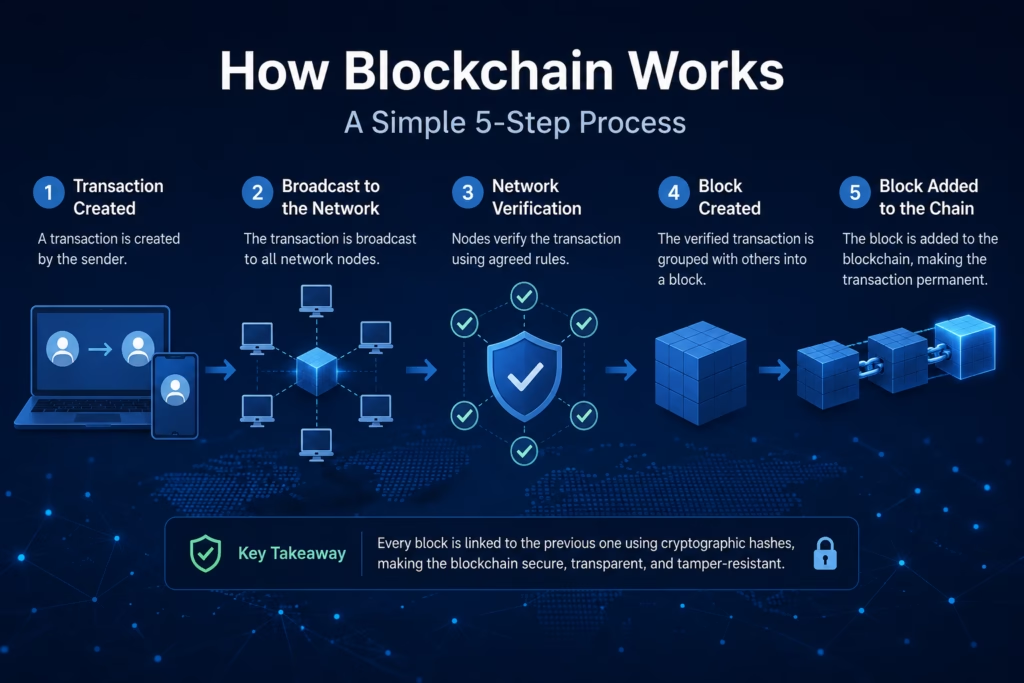
Instead of one person owning the notebook, thousands of computers around the world keep identical copies. Whenever a new page is added, everyone updates their copy. Before that page becomes permanent, the network checks whether the information is valid.
This process allows participants to trust the data without depending on a single authority.
The Blockchain Process in Five Simple Steps
Every blockchain transaction follows a sequence.
Step 1 — A Transaction Is Created
Suppose Alice wants to send Bitcoin to Bob.
She opens her wallet and creates a transaction containing:
- Sender’s address
- Receiver’s address
- Amount
- Digital signature
At this stage, the transaction has been created but not yet confirmed.
Step 2 — The Transaction Is Broadcast
Instead of sending the transaction to a bank, Alice’s wallet broadcasts it to thousands of computers connected to the blockchain network.
These computers are called nodes.
Every node receives the same transaction almost simultaneously.
Step 3 — The Network Verifies the Transaction
Each node checks several important rules.
For example:
- Does Alice actually own the Bitcoin?
- Has she already spent these coins elsewhere?
- Is the digital signature valid?
- Does the transaction follow the network protocol?
If these checks pass, the transaction becomes eligible to enter the next block.
Step 4 — A New Block Is Created
Verified transactions are grouped together into a new block.
Think of a block as a page in a digital ledger.
A single block usually contains many verified transactions rather than just one.
Step 5 — The Block Is Added to the Chain
Once the network reaches consensus, the new block is attached to the previous block.
Because every block references the one before it, they form a continuous chain.
This is where the name blockchain comes from.
💡 Key Takeaway
A blockchain is not a single file stored on one server.
It is a continuously growing chain of verified blocks shared across thousands of computers.
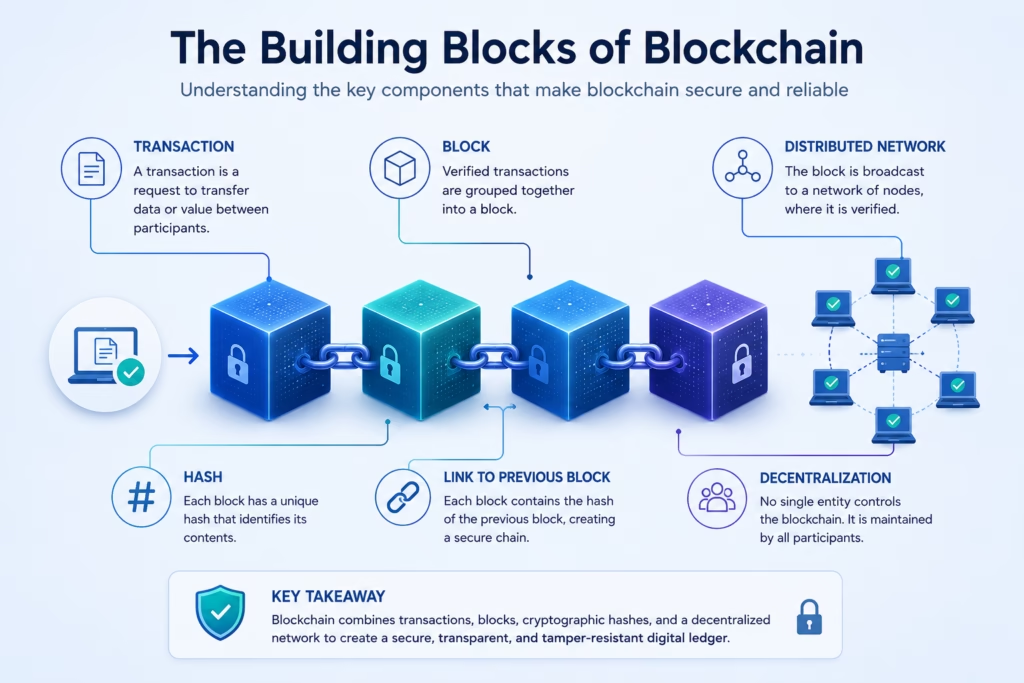
What Is a Block?
A block is simply a container that stores information.
Depending on the blockchain, a block may contain:
- Verified transactions
- Timestamp
- Block number
- Previous block hash
- Current block hash
- Additional network information
When the block is completed, it is permanently linked to the previous block.
What’s Inside a Block?
Imagine every block as a sealed package.
Each package contains:
📦 Transaction Data
↓
🕒 Timestamp
↓
🔑 Previous Block Hash
↓
🔒 Current Block Hash
↓
📑 Additional Metadata
This structure allows the network to verify the integrity of every block.
What Is a Hash?
A hash is one of blockchain’s most important security features.
A hash is a unique digital fingerprint generated from the contents of a block.
Even a tiny change in the data produces a completely different hash.
For example:
Original text:
Alice sends Bob 1 BTC
Hash (illustrative):
9A73F18D...Now change just one number.
Alice sends Bob 2 BTC
The resulting hash becomes completely different.
This behavior makes unauthorized modifications easy to detect.
Real-Life Analogy
Imagine a document protected by a tamper-evident security seal.
If someone opens the envelope, the seal immediately shows signs of damage.
A blockchain hash works in a similar way.
If someone changes the stored information, the digital fingerprint changes instantly.
⚠ Common Mistake
Many beginners think a hash encrypts data.
It doesn’t.
A hash is primarily used to verify integrity, not to hide information.
What Is the Previous Hash?
Every block contains the hash of the previous block.
This creates a secure link between blocks.
Example:
Block 1
Hash: A45...

↓

Block 2
Previous Hash: A45...
Hash: C91...

↓

Block 3
Previous Hash: C91...
Hash: F83...
Because each block depends on the previous one, changing a single block would require recalculating every following block.
On large public blockchains, this becomes extremely difficult in practice.
What Is a Distributed Ledger?
Traditional databases usually have one central owner.
Blockchain works differently.
Thousands of computers maintain identical copies of the same ledger.
Whenever a new block is confirmed, every participant updates their copy.
There is no single master database.
Instead, the ledger is distributed across the network.
Traditional Database vs Blockchain
| Traditional Database | Blockchain |
|---|---|
| Controlled by one organization | Shared across many participants |
| Administrator can modify records (subject to permissions) | Historical records are designed to be highly resistant to unauthorized modification |
| Central server | Distributed network |
| Single point of failure | No single central point controlling the ledger |
| Updates depend on administrator permissions | Updates follow network consensus rules |
Why Is Blockchain Considered Secure?
Blockchain security comes from multiple layers working together.
Cryptography
Every transaction uses cryptographic techniques to help verify authenticity.
Distributed Copies
Thousands of independent computers maintain copies of the ledger.
Consensus
Participants agree before new blocks become part of the blockchain.
Linked Blocks
Every block references the previous one using hashes.
Transparency
Public blockchains allow participants to independently verify transaction history.
📌 Did You Know?
Changing information in one block is not enough.
On public blockchains, an attacker would also need to alter every subsequent linked block while overcoming the network’s consensus mechanism—a task that becomes increasingly impractical as the network grows.
Why Can’t Someone Simply Edit the Blockchain?
Imagine printing 100,000 identical history books and distributing them around the world.
If one person secretly edits page 52 in their own copy, everyone else’s copies still contain the original version.
The incorrect copy immediately stands out.
Blockchain follows a similar principle.
Because thousands of participants maintain synchronized copies, unauthorized changes are detectable and inconsistent with the network’s agreed history.
Key Takeaways
Before moving to blockchain applications, remember these concepts:
- A transaction is created.
- Nodes verify the transaction.
- Verified transactions form a block.
- Blocks are linked using cryptographic hashes.
- Every participant stores a copy of the ledger.
- Consensus helps determine which blocks become part of the blockchain.
Public Blockchain vs Private Blockchain
Not every blockchain works the same way.
Although Bitcoin introduced the concept of a public blockchain, many organizations today also use private or permissioned blockchains for specific business purposes.
The biggest difference lies in who is allowed to participate and who controls access.
Public Blockchain
A public blockchain is open to everyone.
Anyone can:
- Join the network
- Verify transactions
- View the blockchain
- Run a node (depending on the blockchain)
- Participate without requesting permission
Examples include:
- Bitcoin
- Ethereum
Public blockchains prioritize transparency, decentralization, and security.
Private Blockchain
A private blockchain is controlled by a single organization or a group of approved participants.
Only authorized users can access or validate transactions.
Private blockchains are often used in:
- Banking
- Healthcare
- Supply chain management
- Enterprise software
Their primary goal is efficiency and controlled data sharing rather than complete decentralization.
Comparison Table
| Public Blockchain | Private Blockchain |
|---|---|
| Open to everyone | Restricted access |
| Highly decentralized | Managed by one or more organizations |
| Greater transparency | Greater privacy |
| Usually slower | Usually faster |
| Best for public networks | Best for enterprise solutions |
💡 Key Takeaway
Bitcoin uses a public blockchain, but blockchain technology itself is flexible enough to support both public and private networks depending on the use case.
How Do Blockchain Networks Agree?
Imagine thousands of computers receiving new transactions at the same time.
How do they decide which transactions are valid?
This process is called consensus.
Consensus is simply the method a blockchain uses to ensure that every participant agrees on the current state of the ledger.
Different blockchains use different consensus mechanisms.
The two most widely known are Proof of Work (PoW) and Proof of Stake (PoS).
Proof of Work (PoW)
Proof of Work is the consensus mechanism introduced by Bitcoin.
In this system:
- Miners compete to solve complex mathematical puzzles.
- The first miner to solve the puzzle earns the right to add the next block.
- The successful miner receives a block reward and transaction fees.
Proof of Work is known for its strong security but also requires significant computing power and energy consumption.
Proof of Stake (PoS)
Proof of Stake takes a different approach.
Instead of competing with computing power, participants lock (or stake) their cryptocurrency to help validate transactions.
The network selects validators based on predefined rules.
Because it does not require intensive mining, Proof of Stake generally consumes much less energy than Proof of Work.
Many newer blockchain networks use PoS or variations of it.
Proof of Work vs Proof of Stake
| Proof of Work | Proof of Stake |
|---|---|
| Uses mining | Uses staking |
| High energy consumption | Lower energy consumption |
| Bitcoin uses PoW | Many modern blockchains use PoS |
| Security through computational work | Security through economic incentives |
⚠ Common Mistake
Many people assume that one consensus mechanism is universally better than the other.
In reality, each approach has different trade-offs involving security, decentralization, scalability, and energy use.
Advantages of Blockchain
Blockchain technology offers several benefits that make it attractive for different industries.
Transparency
Public blockchain transactions can be independently verified by anyone.
This transparency reduces the need to rely solely on a central record keeper.
Security
Cryptography, distributed ledgers, and consensus mechanisms work together to help protect blockchain data against unauthorized changes.
Decentralization
Instead of relying on one central organization, blockchain distributes responsibility across many participants.
This reduces dependence on a single point of control.
Traceability
Every transaction is recorded in chronological order.
This creates an auditable history that can be useful in industries such as logistics, healthcare, and finance.
Availability
Because multiple copies of the ledger exist across the network, blockchain systems can remain operational even if some participants go offline.
Challenges and Limitations
Blockchain is a powerful technology, but it is not the right solution for every problem.
Understanding its limitations is just as important as understanding its strengths.
Scalability
Some public blockchains process fewer transactions per second than traditional payment systems.
Developers continue working on solutions to improve scalability.
Energy Consumption
Some consensus mechanisms, particularly Proof of Work, require substantial computing resources.
This has led to ongoing discussions about sustainability and efficiency.
Storage Requirements
As blockchain networks grow, storing the complete transaction history can require significant storage capacity for full nodes.
Regulatory Uncertainty
Blockchain regulations continue evolving around the world.
Legal requirements differ by country and may change over time.
Complexity
Blockchain concepts such as cryptography, consensus, wallets, and smart contracts can be difficult for beginners to understand without proper education.
Real-World Applications of Blockchain
Blockchain is often associated with cryptocurrency, but its potential extends far beyond digital payments.
Financial Services
Banks and financial institutions are exploring blockchain for faster settlements, cross-border payments, and asset tokenization.
Supply Chain Management
Companies can use blockchain to track products from manufacturers to consumers, improving transparency and traceability.
Healthcare
Medical records can be shared more securely between authorized healthcare providers while maintaining an audit trail.
Digital Identity
Blockchain-based identity systems aim to give individuals greater control over personal credentials.
Government Services
Some governments have experimented with blockchain for land records, public registries, and digital documentation.
Voting Systems
Researchers continue exploring blockchain as one possible technology for improving transparency in certain voting processes, although practical implementation presents significant technical and legal challenges.
Intellectual Property
Blockchain can be used to timestamp creative works and establish verifiable records of ownership or publication.
📌 Did You Know?
The World Economic Forum has explored multiple blockchain use cases beyond cryptocurrency, including supply chains, digital identity, healthcare, and government services.
Blockchain Is Not a Magic Solution
One common misconception is that every industry needs blockchain.
That is not true. Blockchain is most valuable when multiple independent participants need to share trusted data without relying entirely on one central authority.
For many applications, a traditional database remains faster, simpler, and more cost-effective. Choosing between blockchain and a traditional database depends on the specific problem being solved—not on technology trends.
Key Takeaways
By now, you should understand that:
- Blockchain has multiple forms.
- Public and private blockchains serve different purposes.
- Consensus mechanisms help maintain trust.
- Blockchain offers advantages but also has practical limitations.
- Its applications extend far beyond cryptocurrency.
Common Myths About Blockchain
As blockchain technology has become more popular, several misconceptions have also spread. Understanding the difference between myths and facts can help readers make more informed decisions.
Myth 1 — Blockchain and Bitcoin Are the Same Thing
This is one of the most common misconceptions.
Bitcoin is a cryptocurrency.
Blockchain is the technology that records and verifies transactions.
While Bitcoin uses blockchain, blockchain technology has many other applications beyond cryptocurrencies.
Myth 2 — Blockchain Cannot Be Hacked
Blockchain networks are designed with strong security mechanisms, but no technology is completely immune to risk.
In many reported cryptocurrency thefts, attackers targeted:
- Cryptocurrency exchanges
- Wallet providers
- Smart contract vulnerabilities
- Phishing attacks
- Poor security practices
These incidents do not necessarily mean that the underlying blockchain itself was compromised.
Myth 3 — Blockchain Is Completely Anonymous
Public blockchains are transparent.
Every transaction is permanently recorded and can be viewed by anyone.
Although wallet addresses are not directly linked to names, blockchain activity can often be analyzed using publicly available data and other information.
Myth 4 — Every Business Needs Blockchain
Blockchain is not a universal solution.
For many applications, a traditional database is more efficient, easier to maintain, and less expensive.
Blockchain is most useful when multiple independent parties need to maintain a shared, tamper-resistant record without relying on a single central authority.
Myth 5 — Blockchain Stores Only Cryptocurrency
Blockchain can store many different types of information.
Examples include:
- Digital identities
- Supply chain records
- Property ownership records
- Healthcare information
- Academic certificates
- Smart contract data
Cryptocurrency is just one application.
💡 Key Takeaway
Blockchain is a powerful technology, but understanding both its capabilities and its limitations is essential before evaluating where it can be used effectively.
Common Beginner Mistakes
Many people become interested in blockchain because of cryptocurrency headlines.
However, understanding the technology requires looking beyond market prices.
Here are some common mistakes beginners make.
Confusing Blockchain With Bitcoin
Blockchain is the technology.
Bitcoin is one application built using that technology.
Learning Only Through Social Media
Short videos and viral posts often simplify or exaggerate blockchain concepts.
Whenever possible, verify important information using trusted educational resources and official documentation.
Ignoring Security
Anyone experimenting with blockchain applications or cryptocurrency should understand the importance of private keys, wallet backups, and phishing protection.
Believing Every New Project
Thousands of blockchain projects exist today.
Not every project has the same level of technical quality, adoption, or long-term viability.
Independent research remains essential.
Thinking Blockchain Solves Every Problem
Technology should solve real business or technical challenges.
Blockchain is valuable in many scenarios, but it is not the right solution for every application.
Frequently Asked Questions
What is blockchain in simple words?
Blockchain is a shared digital ledger that stores information in connected blocks. Once information is verified and added, it becomes extremely difficult to change without network agreement.
Who invented blockchain?
The concept evolved over several decades. Researchers Stuart Haber and W. Scott Stornetta introduced important timestamping ideas in 1991, while Satoshi Nakamoto combined several technologies to launch Bitcoin in 2009, demonstrating blockchain on a global scale.
Why is blockchain considered secure?
Blockchain combines cryptographic hashing, distributed copies of data, and consensus mechanisms to help protect information against unauthorized modification.
Can blockchain be edited?
New information can always be added.
However, changing previously confirmed records on a public blockchain is designed to be extremely difficult because of cryptographic linking and distributed verification.
Is blockchain only used for Bitcoin?
No.
Blockchain technology is also being explored in finance, healthcare, logistics, digital identity, real estate, insurance, and many other sectors.
What is the difference between blockchain and a database?
A traditional database is generally controlled by a central organization.
A blockchain distributes copies of the ledger across multiple participants and relies on consensus rules to validate updates.
What is a node?
A node is a computer that participates in the blockchain network by storing data, validating information, or helping maintain the network, depending on its role.
What is consensus?
Consensus is the process through which blockchain participants agree on which transactions are valid before adding them to the ledger.
Is blockchain private?
Some blockchains are public, while others are private or permissioned.
The level of transparency depends on the design of the blockchain.
Is blockchain the future?
Blockchain continues evolving and has shown potential in multiple industries.
However, its future adoption will depend on technical improvements, regulation, business needs, and practical use cases.
What Should You Learn Next?
Now that you understand blockchain fundamentals, consider exploring these topics:
- What Is Bitcoin?
- Bitcoin Mining Explained
- Bitcoin Wallet Guide
- Public Key vs Private Key
- How Bitcoin Transactions Work
- What Is A Bitcoin Address?
- What Is Ethereum?
- Smart Contracts Explained
- Proof of Work vs Proof of Stake
- Blockchain Security
These articles build naturally on the concepts covered in this guide.
Must Read : What Is Bitcoin? A Complete Beginner’s Guide (2026)
Final Thoughts
Blockchain introduced a new approach to storing and verifying digital information by combining cryptography, distributed networks, and consensus mechanisms.
Although it first gained worldwide attention through Bitcoin, blockchain technology has expanded into many industries where transparency, security, and shared record-keeping are important.
Like any technology, blockchain is not a solution for every problem. Understanding both its strengths and its limitations allows individuals and organizations to evaluate where it can provide real value.
Whether you are interested in cryptocurrency, financial technology, or digital innovation, learning how blockchain works provides a strong foundation for understanding many of the technologies shaping the modern digital economy.
Disclaimer
This article is intended for educational and informational purposes only.
It should not be considered financial, investment, legal, or professional advice.
Readers should verify important information through official sources and consult qualified professionals before making financial or business decisions.
References
For factual accuracy, review and cite primary sources such as:
- Bitcoin: A Peer-to-Peer Electronic Cash System (Satoshi Nakamoto, 2008)
- Bitcoin.org
- Bitcoin Core Documentation
- Ethereum Foundation Documentation (where applicable)
- Cambridge Centre for Alternative Finance
- World Economic Forum publications on blockchain
- Relevant government or regulatory publications for jurisdiction-specific information